Comment calculer la valeur actuelle
Pour modifier le symbole monétaire ou le format de date, cliquez sur le lien “$ : MM/DD/YYYY” situé en bas à droite de toute calculatrice.
Tutoriel étape par étape
Tutoriel 20
La valeur actuelle est un concept financier essentiel.
Les investisseurs utilisent la valeur actuelle (VA) pour évaluer la valeur des paiements futurs lorsqu’ils envisagent une hypothèque ou un prêt. Les avocats l’appliquent pour estimer la valeur actuelle des flux de trésorerie futurs dans les règlements juridiques. Wikinvest définit la valeur actuelle comme « la valeur d’aujourd’hui d’un ensemble de flux de trésorerie qui se produiront à l’avenir. Elle est calculée en divisant les flux futurs par un taux d’actualisation approprié ». L'Ultimate Financial Calculator est conçu pour calculer la valeur actuelle de tout scénario de flux de trésorerie.
Tous les utilisateurs doivent suivre le premier tutoriel plus détaillé pour comprendre les concepts de base et les paramètres de l’Ultimate Financial Calculator (UFC).
Supposons que vous avez gagné à la loterie. La commission de loterie vous propose deux options :
- Recevez des paiements mensuels de 35 045,00 € pendant 20 ans, ou
- Acceptez un paiement unique de 5 476 123,50 €.
Pour comparer ces options, calculez la valeur actuelle en suivant les étapes suivantes :
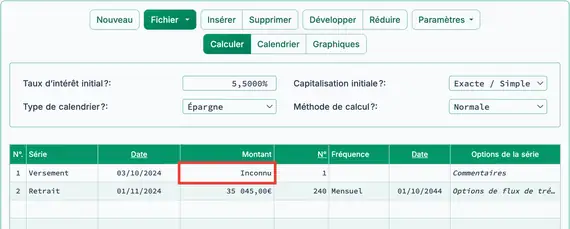
- Définissez type d'échéancier sur « Épargne ».
- Sinon, cliquez sur le bouton pour effacer toutes les entrées précédentes.
- Définissez arrondi sur « Solde ouvert—pas de correction ».
Select . - Dans la section d’en‑tête, appliquez les paramètres suivants :
- Définissez méthode de calcul sur « Normal ».
- Définissez capitalisation initiale sur « Exact/Simple ».
- Définissez le Taux d’intérêt initial à 5,5.
- Ce taux représente votre rendement annuel attendu pour l’investissement du paiement forfaitaire. Il est également appelé le taux d’actualisation.
- Dans la première ligne de la zone d’entrée des flux de trésorerie, créez une série “Retrait” :
- Définissez la Date sur 3 octobre 2024.
- Définissez le Montant sur Inconnu en tapant I. Fig. 1
- Définissez le nombre (de périodes) sur 1.
- Remarque : Comme le nombre de périodes est 1, vous ne pourrez pas définir une fréquence.
- Si vous essayez de définir une fréquence, elle sera effacée lorsque vous quitterez la ligne.
- Dans la deuxième ligne, créez la série attendue des paiements de loterie :
- Sélectionnez “Dépôt”.
- Saisissez la Date comme 1 novembre 2024.
- Ceci est la date prévue du premier paiement de la commission de loterie.
- Saisissez le Montant comme 35 045,00 € (gains périodiques).
- Saisissez 240 pour le Nombre (de périodes).
- Sélectionnez “Mensuel” pour la Fréquence. La Date de fin calculée sera le 1 octobre 2044 (date du paiement final).
- Cliquez sur le bouton .
- Le résultat est 5 063 030,40 €. Fig. 2
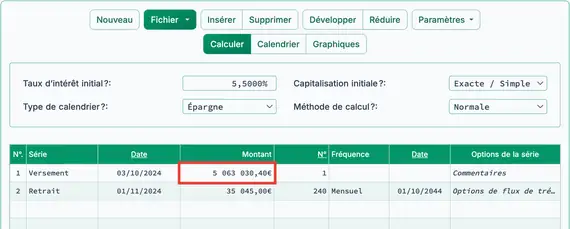
- En supposant un flux de trésorerie futur de 240 dépôts mensuels de 35 045,00 € chacun, la valeur actuelle est de 5 063 030,40 €. Ce montant est inférieur à l’offre forfaitaire de la loterie de 5 476 123,50 €. Sur la base de la valeur seule, le paiement forfaitaire semble être l’option la plus avantageuse.
Remarque 1 : Le flux de trésorerie peut consister en un montant unique ou en une série de dépôts, retraits ou paiements. Vous pouvez définir plusieurs séries si besoin. Lors du calcul de la valeur actuelle, le premier enregistrement doit être réglé sur « Inconnu ». La Date doit être fixée à aujourd’hui, et la Série doit être opposée à la série de flux de trésorerie future.
Remarque 2 : Cet exemple ne prend pas en compte les impôts. Les impôts peuvent affecter considérablement le résultat. Consultez un professionnel fiscal qualifié avant de prendre une décision financière.
Remarque 3 : Cet exemple ne traite pas non plus du risque d’investissement. Si vous acceptez le paiement forfaitaire, êtes‑vous sûr de pouvoir l’investir pour atteindre la valeur totale des paiements futurs ? Si vous choisissez les paiements mensuels, existe‑t‑il un risque que le fournisseur ne réalise pas chaque paiement ? Si les paiements futurs sont incertains, accepter une somme forfaitaire plus petite peut être plus sûr.
Retour à Ultimate Financial Calculator.