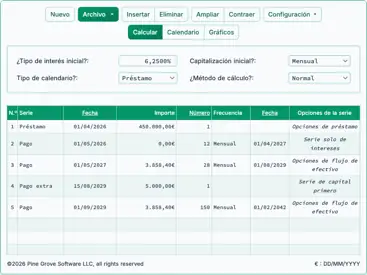
calculadora de valor futuro de una anualidad
Introducción al valor futuro de una anualidad
Una anualidad, tal como se utiliza aquí, es una serie de pagos o retiros periódicos y regulares de una cuenta de inversión. Wikipedia enumera los siguientes ejemplos de anualidades: “depósitos regulares en una cuenta de ahorros, pagos mensuales de hipoteca, pagos mensuales de seguros y pagos de pensiones”. Las anualidades pueden clasificarse según la frecuencia de las fechas de flujo de caja. El inversor puede realizar depósitos, retiros o pagos de forma semanal, mensual, trimestral, anual o en cualquier otro intervalo regular. Esta calculadora admite 11 opciones de frecuencia.
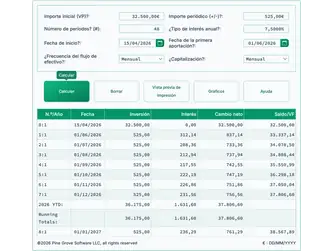
The Accurate Future Value of an Annuity Calculator calculates the FV of a series of periodic amounts.
- Cree tablas imprimibles con fechas
- Exporte o imprima gráficos
“¿Cuál será el valor final de una serie de depósitos, retiros o inversiones?”
El valor futuro de una anualidad es la cantidad total que el flujo de efectivo tendrá en una fecha futura especificada. Debido a que la cuenta genera ganancias de inversión o intereses sobre el capital, el valor final es mayor que la suma de los depósitos.
Esta calculadora del valor futuro de una anualidad (FVA) calcula el valor en cualquier fecha futura especificada. Puede introducir una cantidad inicial que difiera del depósito periódico. Esto le permite calcular el FVA de una inversión existente.
Si la inversión es nueva, establezca el campo “Importe inicial (PV)” a 0.
Esta calculadora de valor futuro de una anualidad también puede calcular el valor futuro después de una serie de retiros. Por ejemplo, si comienza con 1.000.000 €, y supone que genera un 4,0 % anual, la calculadora calculará el valor tras 30 años de retiros mensuales de 5.000 €. Para indicar un retiro, introduzca una cantidad negativa.
Valor futuro de una anualidad‑calcule el valor de una serie de inversiones o depósitos
Para establecer su moneda y formato de fecha preferidos, haga clic en el enlace “$ : MM/DD/YYYY” en la esquina inferior derecha de cualquier calculadora.
Información
Instrucciones para la calculadora de valor futuro de una anualidad
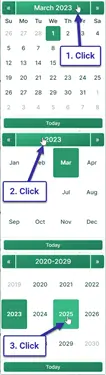
Rápidamente
Elija una fecha
- Importe inicial (PV): La cantidad de dinero que tiene al comienzo del período de la anualidad. Puede ser la inversión inicial o el valor actual de una anualidad existente.
- Importe periódico: La cantidad de dinero que retirará (introduzca un valor negativo) o aportará (introduzca un valor positivo) a intervalos regulares. Los términos de la anualidad determinan tanto el importe como la frecuencia.
- Número de períodos: El número de veces que se producirá el flujo de efectivo periódico.
- Tasa de interés anual: La tasa de interés anual que generará la anualidad, expresada como porcentaje.
- Fecha de inicio: La fecha del valor presente (ver nota abajo). Puede ser la fecha en que adquiere la anualidad u otra fecha predeterminada.
- Fecha de la primera aportación: La fecha de la primera contribución o retiro de la anualidad. Puede coincidir con la fecha de inicio o ser una fecha posterior.
- Frecuencia del flujo de efectivo: Con qué frecuencia contribuirá o retirará de la anualidad. Ejemplos: mensual, trimestral, anual u otro intervalo regular.
- Capitalización mensual: Con qué frecuencia se capitaliza el interés de la anualidad. Si no está seguro, establezca este valor para que coincida con la frecuencia del flujo de efectivo.
Nota: Una anualidad es un flujo de efectivo regular—programa de contribuciones o retiros. Dado que esta calculadora permite especificar tanto una fecha de inicio como una fecha del primer flujo de efectivo que pueden ser diferentes, puede calcular el valor futuro con precisión. Esto sigue siendo cierto incluso si los flujos de efectivo no comienzan hasta años después.
Ecuaciones para el valor futuro de una anualidad
En esta sección:
Ecuación del valor futuro de una anualidad ordinaria (con un importe inicial)
Para una anualidad ordinaria, los flujos de efectivo ocurren al final de cada período. Para modelar esto, establezca “Fecha de la primera aportación” a cualquier fecha posterior a “Fecha de inicio.” La calculadora admite un primer período irregular (stub), pero la ecuación no.
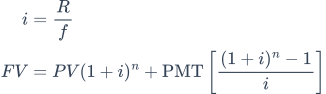
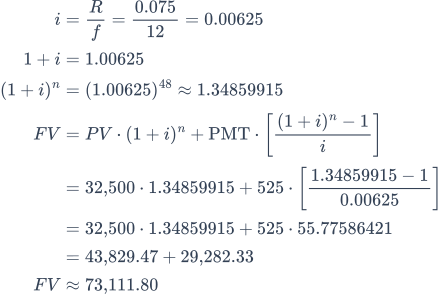
Fig. 2 – Solución paso a paso de la ecuación del valor futuro de una anualidad ordinaria.
Variables: PV = 32.500; PMT = 525; R = 7,5 %; n = 48; f = 12.
Definiciones de variables
- R
- Tipo de interés anual nominal.
- f
- Número de períodos de capitalización por año.
- i
- Tasa de interés periódica.
- PV
- Valor presente — el importe inicial (puede ser 0).
- PMT
- Importe del flujo de efectivo periódico. Todos los flujos son iguales.
- n
- Número total de flujos de efectivo.
Pasos de cálculo explicados – Fig. 2
- ¿Cómo se calcula el valor futuro de una anualidad ordinaria con un importe inicial?
Para calcular el valor futuro de una anualidad ordinaria con un valor presente (importe inicial), utilice una ecuación de interés compuesto que tenga en cuenta tanto el capital inicial como una serie de pagos iguales realizados al final de cada período. El proceso es el siguiente, usando estos datos de entrada:
PV = 32.500,PMT = 525,n = 48meses,R = 7,5 %de tipo de interés anual, yf = 12períodos de capitalización al año.- Calcule la tasa de interés periódica dividiendo la tasa anual nominal entre el número de períodos de capitalización al año:
i = R ÷ f = 0,075 ÷ 12 = 0,00625. - Sume 1 a la tasa periódica:
1 + i = 1,00625. - Eleve la base a la potencia del número total de períodos:
(1,00625)48 ≈ 1,34859915. - Sustituya los valores en la ecuación del valor futuro:
FV = PV × (1,00625)48 + PMT × [(1,00625)48 − 1] ÷ 0,00625. - Evalúe cada parte:
32.500 × 1,34859915 ≈ 43.829,47;525 × 55,77586421 ≈ 29.282,33. - Sume ambas partes para calcular el valor futuro:
43.829,47 + 29.282,33 = 73.111,80.
Un depósito inicial de 32.500 € más 48 pagos mensuales de 525 €, invertidos a un tipo de interés anual del 7,5 % capitalizado mensualmente, crecerá aproximadamente a 73.111,80 € al final del período de inversión.
- Calcule la tasa de interés periódica dividiendo la tasa anual nominal entre el número de períodos de capitalización al año:
Solución paso a paso – Fig. 2
FV = 32.500 × (1,00625)48 + 525 × [(1,00625)48 − 1] ÷ 0,00625≈ 32.500 × 1,34859915 + 525 × (0,34859915 ÷ 0,00625)≈ 32.500 × 1,34859915 + 525 × 55,77586421≈ 43.829,47 + 29.282,33≈ 73.111,80
Respuesta final
La respuesta final (FV) es aproximadamente 73.111,80.
Validar la calculadora. Entradas para una tabla de valor futuro de 48 meses.
| Importe inicial (VP): | 32.500,00 | Importe periódico (+/‑): | 525,00 |
|---|---|---|---|
| Número de períodos: | 48 | Tasa de interés anual: | 7,5 % |
| Fecha de inicio: | Fecha de la primera aportación: | ||
| Frecuencia del flujo de efectivo: | Mensual | Capitalización: | Mensual |
| Núm./Año | Fecha | Inversión | Interés | Cambio neto | Saldo/VF |
|---|---|---|---|---|---|
| 47:4 | 525,00 | 444,79 | 969,79 | 72.135,97 | |
| 48:4 | 525,00 | 450,85 € | 975,85 € | 73.111,82 € | |
| 2029 acumulado: | 4.200,00 € | 3.439,18 € | 7.639,18 € | ||
| Totales acumulados: | 57.700,00 € | 15.411,82 € | |||
| El valor futuro es 0,02 € superior al resultado de la ecuación porque el calendario redondea los intereses intermedios a dos decimales. | |||||
Notas:
- Este ejemplo utiliza el mismo cálculo que en la Fig. 2.
- Si ejecuta este ejemplo en esta calculadora, el valor futuro es 73.111,82. Esta diferencia se produce porque la calculadora genera un calendario mensual y redondea cada importe de interés a dos decimales, pero la ecuación en forma cerrada no redondea los valores intermedios.
- El importe inicial puede ser 0.
Ecuación del valor futuro de una anualidad anticipada (con un importe inicial)
Para una anualidad anticipada, los flujos de efectivo se producen al comienzo de cada período. Para modelarlo, establezca “Fecha de la primera aportación” igual al “Fecha de inicio.”

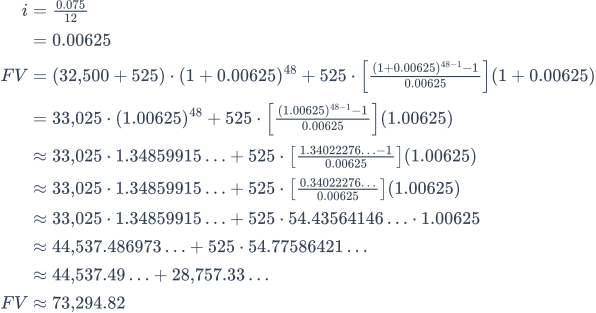
Fig. 4 – Solución paso a paso del valor futuro de una ecuación de anualidad anticipada.
Variables: PV = 32.500; PMT = 525; R = 7,5 %; n = 48; f = 12.
Definiciones de variables
- R
- Tipo de interés anual nominal.
- f
- Número de períodos de capitalización por año.
- i
- Tasa de interés periódica.
- PV
- Valor presente — el importe inicial (puede ser 0).
- PMT
- Importe del flujo de efectivo periódico. Todos los flujos son iguales.
- n
- Número total de flujos de efectivo.
Pasos de cálculo explicados – Fig. 4
- ¿Cómo se calcula el valor futuro de una anualidad anticipada con un importe inicial?
El cálculo combina el crecimiento del capital único inicial con el crecimiento de la corriente de flujos de una anualidad anticipada. La tasa periódica se deriva de la tasa de interés anual nominal (APR) y la frecuencia de capitalización. Luego los valores se sustituyen en la ecuación y se simplifica paso a paso. Las aproximaciones se indican con puntos suspensivos.
- Calcule la tasa periódica a partir del APR nominal y la frecuencia de capitalización:
i = R ÷ f = 0.075 ÷ 12. - Evalúe la tasa periódica:
i = 0.00625. - Sustituya en la ecuación combinada de valor futuro (capital único más anualidad anticipada):
FV = (32,500 + 525) × (1 + 0.00625)48 + 525 × [((1 + 0.00625)48 − 1 − 1) ÷ 0.00625] × (1 + 0.00625). - Simplifique la base manteniendo la forma exponencial:
FV = 33,025 × (1.00625)48 + 525 × [((1.00625)48 − 1 − 1) ÷ 0.00625] × (1.00625). - Aproxime los factores de crecimiento:
(1.00625)48 ≈ 1.34859915…y(1.00625)47 ≈ 1.34022276…. Actualice el paréntesis:FV ≈ 33,025 × 1.34859915… + 525 × [(1.34022276… − 1) ÷ 0.00625] × 1.00625. - Simplifique dentro del paréntesis:
FV ≈ 33,025 × 1.34859915… + 525 × (0.34022276… ÷ 0.00625) × 1.00625. - Divida el paréntesis y mantenga el multiplicador de tiempo:
FV ≈ 33,025 × 1.34859915… + 525 × 54.43564146… × 1.00625. - Calcule el producto del capital único y mantenga el factor de anualidad:
FV ≈ 44,537.49… + 525 × 54.77586421…. - Multiplique la cuota periódica por el factor ajustado:
FV ≈ 44,537.49… + 28,757.33…. - Sume ambas partes y redondee a dos decimales:
FV ≈ 73,294.82.
Este procedimiento hace crecer el capital único inicial a lo largo de todos los períodos y añade la corriente de flujos de una anualidad anticipada con el ajuste de tiempo al comienzo del período.
- Calcule la tasa periódica a partir del APR nominal y la frecuencia de capitalización:
Solución paso a paso – Fig. 4
i = 0.075 ÷ 12= 0.00625FV = (32,500 + 525) × (1 + 0.00625)48 + 525 × [((1 + 0.00625)48 − 1 − 1) ÷ 0.00625] × (1 + 0.00625)= 33,025 × (1.00625)48 + 525 × [((1.00625)48 − 1 − 1) ÷ 0.00625] × (1.00625)≈ 33,025 × 1.34859915… + 525 × [(1.34022276… − 1) ÷ 0.00625] × 1.00625≈ 33,025 × 1.34859915… + 525 × (0.34022276… ÷ 0.00625) × 1.00625≈ 33,025 × 1.34859915… + 525 × 54.43564146… × 1.00625≈ 44,537.486973… + 525 × 54.77586421…≈ 44,537.49… + 28,757.33…≈ 73,294.82
Respuesta final
La respuesta final (FV) es aproximadamente 73,294.82 al final del 48.º período.
Notas:
- Para una anualidad anticipada, el calendario de la calculadora se detiene al comienzo del período final. Como resultado, la salida del calendario será inferior al resultado de la ecuación en la cantidad de intereses devengados en ese período final. Este comportamiento puede cambiar en una futura actualización de la calculadora.
- El importe inicial puede ser 0.
Ayuda de la calculadora de valor futuro de una anualidad
El dinero—incluido el efectivo, las inversiones y los créditos—tiene un valor diferente en el futuro que hoy. Incluso el efectivo que no genera intereses perderá valor con el tiempo. Este cambio de valor se denomina “valor futuro”.
Debe introducir o bien un “Importe inicial” (el efectivo disponible al inicio), un “Importe de la aportación periódica”, o ambos. Defina la frecuencia con la que aporta a la inversión seleccionando “Frecuencia de aportación.” Por ejemplo, si las aportaciones son mensuales y introduce 120 en “Número de aportaciones”, el “Valor futuro (VF)” se calcula para la fecha que está 10 años después del “Fecha de la primera aportación” (120 aportaciones mensuales = 10 años).
Frecuencia de capitalización: Elegir la opción “Exact/Simple” significa que la calculadora no capitaliza intereses. Calcula el interés de cada período usando el número exacto de días entre las fechas de flujo de efectivo. La opción “Diario” también usa recuentos exactos de días, pero asume capitalización diaria (el interés se añade al principal cada día). La configuración “Exact/Simple” es la más conservadora y produce el valor futuro más bajo. La capitalización diaria genera un valor futuro mayor (cerca del máximo salvo para “Capitalización continua”).
Otras frecuencias de capitalización se basan en períodos superiores a un día. Cada período se trata como igual en duración para los cálculos de interés. Por ejemplo, si el saldo es 10.000 €, el interés devengado en enero será igual al de febrero, suponiendo la misma tasa anual de interés.
Nota: El valor futuro puede ser inferior al valor actual cuando se considera la inflación. Para reflejar esto, introduzca una tasa de interés negativa.
Comments, suggestions & questions welcomed...