Login
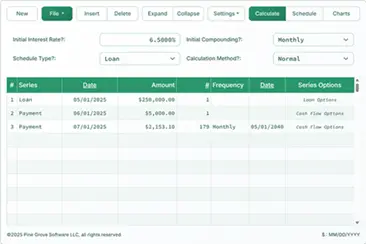
Screenshot of the Ultimate Financial Calculator interface

Ultimate Financial Calculator Promotional Section

Pick your colors:

Accurate Investment Calculator™

Optionally considers inflation, taxes and fees.
advertisement

An Introduction to the Investment Calculator

Your device is too small to show this calculator.
Please rotate to see calculator
Please rotate device or widen browser for a better experience.
Accurate Investment Calculator™
Accurate Investment Calculator

Investment income calculator solves for multiple unknowns and creates printable investment and income schedules.

  • Optionally considers inflation, taxes and/or fees
  • Calculates what’s required to reach a goal
  • Create either investment(+) or income(-) schedules
  • Export schedules to XLSX/DOCX files

How serious are you about investing?

If you are serious, this investment calculator is for you. Many investment tools published by other sites will show you how much you will have after “X” years, assuming a “Y” rate of return. However, many of these other tools do not consider the impact of inflation, taxes, or fees on your investment results.

That type of calculation is not sufficient for investment planning.

If you ignore these factors, you are making an investment plan based on incomplete information. My calculators are designed for serious analysis. Spend a few minutes with this compound growth calculator, and whether you are investing for income or a future expense, you will gain clearer insight into your financial future. More below…

Your device is too small to show this calculator.
Please rotate to see calculator
Please rotate device or widen browser for a better experience.

The Calculator-solve for multiple unknowns


To set your preferred currency and date format, click the “$ : MM/DD/YYYY” link in the lower-right corner of any calculator.

Investment Plan - Type “U” for One “Unknown”
Required inputs.
Enter the date manually or use the calendar button to pick one.
Optional Settings - Any or all can be “0”
Optional settings
Whether or not state taxes are deductible on Federal tax return.
If “No”, taxes are calculated on investment gain.
Results
Investment results and analysis.
©2026 Pine Grove Software LLC, all rights reserved
$ : MM/DD/YYYY
Click to make smaller (-) or larger (+).

Getting Started

Note for income cash flow type: When “Periodic Withdrawal Amount” is set to “Unknown” and “Annual Inflation Rate” is not equal to “0,” this calculator computes an inflation-adjusted cash flow that continues for the number entered in “Number of Cash Flows.” This means the initial withdrawal amount will be lower than it would be without inflation adjustments. Most other calculators start withdrawals from an unadjusted initial amount, so their schedules end before the specified term when inflation is applied. With this calculator, you can instead enter any withdrawal amount and an inflation rate, and the calculator will use those values for the schedule (enter “Unknown” for the number of withdrawals).

Date selection via pop-up calendar

Quickly
Pick a Date

Click “Help” for a concise explanation.

First, review a few of the high-level features of this calculator. Do not be concerned with all the options; each one will be discussed in the following steps.

The upper part of the calculator has two sections. Ignore the “Optional Settings” on the right for now. Leave those inputs set to zero. When the inputs are all zero, the other yes/no options have no effect.

The section labeled “Investment Plan” is the core of the calculator, and the first six inputs are the most important ones. If you understand these first six inputs and how they relate to each other, the remaining settings will be straightforward.

A Dual Investment Tool

Notice the “Cash Flow Type” setting.

The periodic additions to or withdrawals from the investment are collectively the cash flow. The “Cash Flow Type” setting controls whether the cash flow is an addition to the “Starting Amount” (investment (+)) or a withdrawal from the “Starting Amount” (income (-)). If you select “Income,” set “Starting Amount (PV)” greater than “Goal Amount.” If you select “Investment,” set “Starting Amount” less than “Goal Amount.”

People frequently invest so they will have enough saved at a future date to generate an income stream. How much savings will you need to produce the income you want? This calculator will calculate that amount.

Investing for Income

Investing for income is a two-step calculation that also demonstrates the flexibility of this calculator.

Follow these steps.

How much should I have in my investment account when I need to depend on it for income?

First, how much income do you want?

For this example, assume $3,000 per month.

How long should this income last?

Assume 25 years, or 300 months.

Set “Cash Flow Type” to “Income.”

Enter “Unknown” for “Starting Amount.”

Enter 3,000 for “Periodic Withdrawal Amount” (or whatever future income you want).

Enter 300 for “Number of Cash Flows.”

Enter an “Annual Rate of Return (ROR)” that reflects the rate you expect your investment to earn. For this example, use 4.5%.

Set “Goal Amount (FV)” to 0.00. Because you are withdrawing from the investment and want the income to last for 300 months, the goal at the end of the term is 0.00; the account balance will be zero after the last withdrawal.

You can adjust the dates as needed. For this example, set both dates to May 5.

Leave the “Investment/Income Frequency” and “Compounding” set to “Monthly.”

The calculator is now ready to answer the question: what starting amount is required to receive the desired income for the planned number of months?

Click “Calc,” and the result is $542,000.00 (rounded up). This amount will be used in step two.

How much do I have to invest periodically to reach my goal?

Change the “Cash Flow Type” to “Investment.”

Set the “Starting Amount” to whatever the current balance is in your investment account(s). For this example, assume the current balance is 0, so enter 0.00.

Set the “Periodic Investment Amount” to “Unknown.”

How much time is remaining before you want to start receiving the income?

Assume 30 years.

How frequently do you want to make additional investments?

Assume four times per year, or quarterly.

Therefore, for “Number of Cash Flows,” enter 120 (4 times per year for 30 years), and set the “Investment/Income Frequency” to “Quarterly.”

Set the “Annual Rate of Return” to a value that reflects your assumptions. You may choose a higher rate than in the first calculation. For this example, use 6%.

Set the “Goal Amount” to $542,000. (This is the result of the first calculation.)

Set the two dates as needed. In this example, leave “Today’s Date” set to May 5. Set the “First Cash Flow Date” to the date you expect to start making contributions to the investment. If you want to tie the contributions to your pay period, set it to a pay day; in this example, use June 1.

Click “Calc.” The result is $1,636.

Invest $1,636 every quarter. If the investment earns the assumed rate of return, the balance will reach the required $542,000 after 30 years, which is sufficient to provide the desired income.

You can verify the result by clicking the “Schedule” button and reviewing the final balance amount.

This example shows that a single calculator can support both the income and accumulation calculations.

advertisement

There is more to this Investment Calculator

What about the “Optional Settings”? How do they work?

That is an important question.

If you have reviewed even basic investing materials, you have likely seen statements such as “examples shown do not reflect actual investment results.”

A significant reason for this is that the tools used to illustrate compound growth and investment income often do not consider the effects of taxes, inflation, and potential investment fees.

This calculator includes these important factors.

Here is how they work.

Impact of Inflation on Investing

In the “Optional Settings” section, enter an average “Annual Inflation Rate.” If you want to use a historically based rate, the Bureau of Labor Statistics publishes historical U.S. Consumer Price Index data back to 1914. If you average the CPI for those years, inflation in the United States has averaged about 3.2% per year. (Review this Inflation Calculator. It will calculate the CPI average for any range of years.)

If you enter an assumed inflation rate and set “Adjust Cash Flow for Inflation” to “Yes,” the income or investment cash flows will adjust on the first cash flow date after January 1.

The $1,636 quarterly investment from the earlier example will need to increase to slightly more than $4,000 per quarter for your results to keep pace with inflation.

Even if you do not want to adjust the cash flow for inflation, you may still want to enter an assumed inflation rate. In the “Results” pane, if “Cash Flow Type” is set to “Investment,” the calculator shows two inflation-adjusted “Goal Amounts.”

“Today’s Value After Inflation” shows the goal amount converted to today’s dollars after adjusting for inflation. Having $542,000 in 30 years at a 3.2% inflation rate is equivalent to having about $211,000 today. The second result, “Inflation Adjust Goal Amount,” shows the amount needed in the future to buy what $542,000 buys today, which is $1,390,000.00.

If you change the “Cash Flow Type” to “Income,” the calculator determines the inflation-adjusted value for the first “Periodic Withdrawal Amount.” If you do not account for inflation and inflation averages 3% over 25 years, a $3,000 income will be equivalent to about $1,300 in today’s dollars, or you would need about $6,600 to maintain the same purchasing power that $3,000 has today.

Income Taxes and Investing

Taxes can significantly affect your investment results if you pay taxes directly from the investment account. If you pay taxes using investment funds, enter your marginal tax rates as needed.

Generally, if an investment is not tax-free, taxes are owed on realized gains. The calculator treats investment gains (ROI) as realized, and taxes are deducted on the first cash flow date after the start of each year.

There is one exception. Some investment accounts allow tax deferral. A traditional IRA is an example. With these accounts, income taxes apply to the withdrawal, not to the investment gain as it occurs.

If you want taxes applied to income withdrawals, set “Taxes Calculated on Withdrawal” to “Yes.”

Fees

Some investments require the investor to pay a fee. Fees are calculated in different ways, and no general-purpose calculator can accurately model every scenario.

This calculator uses the percentage you enter and calculates the fee using the year’s average balance. The fee is deducted at the end of the year.

Internal Rate of Return (IRR)

How does an investor compare investments and decide which investment is better? One important factor is the rate of return. The IRR is the return an investment produces, expressed as an annualized percentage.

You can use this calculation to compare investments. There are two IRR values: one before the impact of taxes and fees, and one after taxes and fees. (If your investment has irregular cash flows, use this Internal Rate of Return Calculator to calculate the IRR.)

advertisement

Solving for an Unknown

You can quickly answer the following questions with this calculator.

  • What will be the future value of your investments?
  • How long will your income last?
  • How long will it take to reach your goal?
  • What rate of return must you earn to reach your goal?
  • What rate of return will create the income you need?
  • What will your income be?
  • How much do you have to invest to meet your goal?

The Investment Calculator is one of the newer calculators on this site, and there has not yet been much user feedback. Please comment if you have suggestions to improve the calculator or this documentation.

advertisement

Questions?
Ask them here. We're happy to help.

  • Is there a calculator I could track 3 separate investments at the same time:
    example:
    RRSP
    TFSA
    Company Pension
    I like to see what each would be worth in 5 or10 years. Each one would have different amount of contributions over the years.

    • If by that you mean 3 separate investments at the same time and keep them separate, the answer is no.

      But if they have the same rate-of-return, the problem you have is the different contributions, then you could use Ultimate Financial Calculator. It will allow you to have multiple cash flows with different amounts at different frequencies. Look at the "Investment" cash flow option. If you leave the interest rate set to 0%, it will calculate the ROR based on the contribution and withdrawals.

      • Hi Karl
        I was looking for something like this, where i could plug all the numbers in and it would show me what my 3 investment would each be worth. I assume I could do this in the Ultimate Calculator, but only one at a time to get the value. Just wanted to have all 3 show on the same calculator. So from there I could see which one I would start to drawn from first and which ones I would need to reinvest

        Investment 1 = RRSP
        Open Balance = 20,000
        monthly contributions = 1200
        average rate earn = 5%
        what would the value be in 5 years or 10 years

        Investment 2 = Company Penison
        Open Balance = 20,000
        monthly contributions = 500.00
        average rate earn = 6%
        what would the value be in 5 years or 10 years

        Investment 3 = TFSA
        Open balance = 62,500
        monthly contributions = 500.00
        average rate earn = 4 %
        what would the value you be in 5 years or 10 years

        • I see. No, I’m afraid the calculator allows for one investment at a time. Of course, you can print out the report and work from that for all 3 at the same time.

  • I’m a bit confused by what the “Last cash flow date” shows in the results field. I used the calculator to tell me what principal is required to meet a certain monthly income and entered 360 for the “number of cash flows” (i.e. 30 years). I would expect the “Last cash flow date” to reflect the requested 30 years. But instead it reflects various periods (all less than 30 years) depending on the details of what is chosen for inflation rate, ROR, etc.

    • I can see how that can be confusing. I need to better document what’s happening.

      First, I assume you have the calculator set for income cash flow type.

      Set all the optional settings on the upper right to 0.

      For the first calculation, if you set "Starting Amount (PV)" to "Unknown," the calculator will calculate the starting amount you need to have to allow for your desired withdrawal amount and the cash flow will last 30 years.

      But, if you now change the ROR and do not set the "Starting Amount (PV)" back to "Unknown," and then recalculate, the calculator will adjust the term, not the starting amount. That’s why the ending date will change.

      Now, you mentioned the inflation rate option. If you change only that and recalculate, the last cash flow date will not change. What changes is the "Today’s Value After Inflation" amount. What that value tells you is the purchasing power, in today’s dollars of the last cash flow.

      Does this help?

  • Winggirl Media says:

    Hi. Is the Savings Calc working on mobile? I can’t seem to get it to calc when pressing the calc button? Thanks!

  • Winggirl Media says:

    Hi in response to your email to me: The url is http://www.starstone.eridanus.co.za Thanks!

    • You’re right, on your site, the plugin is not working not mobile (at least on an iPhone). I can’t tell why though. Something is blocking it from loading completely. I can tell this, because when the page loads, notice that there are not any numbers (zeros) populated where the results are displayed.

      Take a look at the savings plugin on this using a mobile device, and you’ll see what I mean.

  • I have tried to calculate a retirement income based on a known retirement pot with an assumed rate of return and also an assumed inflation rate, The income is to be withdrawn monthly and the rate of return calculated annually. I set the number of withdrawals as 288 (24 x 12). No taxes were applied and I had added the management fee. The withdrawal amount was left as unknown
    When calculated, the calculator gave a much lower number of payments but at a much higher value than I had anticipated. Why was the figure in the number in the periodic returns ignored?
    I have used your retirement calculator which is very good but it does not include a inflation or management fee option. As a rough guide I have simply deducted the inflation and management fee percentage from the rate of return to obtain a result. Is this overly simplistic, should I be using this calculator. If so, how do I get it to forecast over the time period that I want?

    • First, I’m sorry not to have replied sooner.

      The value you enter in the number of periods is not being ignored. The calculator uses it for calculating the initial withdrawal amount which means a withdrawal amount that will enable the initial amount (PV) to last for the number of periods you enter. Then, if you enter an inflation rate, the calculator shows the user the impact that inflation has on the cash flow by shortening the cash flow to make up for the inflation adjustments (increases in the withdrawal amount needed) to maintain the same purchasing power that the initial withdrawal has.

      Or from a different perspective, the initial withdrawal amount is not recalculated to a lower value when you enter an inflation rate. When calculating withdrawal and impact of inflation, adjusting the initial calculation would be a circular calculation. If the calculator were to adjust say a $10,000 withdrawal by 4% to maintain the 288 periods, the amount would be lower, but then a 4% adjustment on the lower amount would no longer deplete the PV.

      Or at least that’s my thinking now as to why the calculator is programmed this way. It’s been a few years since I designed it and I may have it wrong on why some decisions were made. I would have to do more research if this doesn’t make sense to you.

      • Thanks for your response, perhaps I am misunderstanding the use of the calculation. I am trying to establish what amount I could draw out as a pension income each month to sustain the investment for 24 years if the following notional figures are entered.
        Cash Flow -Income
        Starting Amount PV – £200,00
        Periodic Investment Amount – Unknown
        Number of cash flows – 288 (24 years monthly)
        ROR -6.8% average over 5 years
        Goal amount -£0
        Todays date – 10/02/2022
        First cash flow – 1/04/2022
        Income frequency – Monthly
        Compounding – Annually
        Inflation – 5%
        Adjust – yes
        Fed tax 0%
        State tax 0%
        Taxes deductible – No
        Taxes on withdrawal – no
        Management fee – 0.48%
        The calculator calculates a monthly income of £1389.98 but not for the period entered ie 24 years the result shows that the income will run out on 31/08/2035 a period of 14 years not 24. I was anticipating the monthly income to be in the region of £700.
        Am I using the calculator incorrectly or is the calculator not intended for this purpose?

        • I may have to get to each question in a few replies. So what I don’t get to now, I’ll get to in a follow-up.

          First I have a question for you. How do you arrive at about a £700 monthly income? If the annualized rate-of-return is 6.8%, and the starting value is £200,000, if you divide that by 288 periods, you’ll get £694 which is not allowing anything for the annual return on the principal. At 6.8% you’ll have income on the 200,000 of nearly £1130/month (200,000 * 0.068) / 12. Now I know that’s not the correct math, because it does not allow for compounding and depletion of principal, but £694+£1130 is a lot more than £700.

          As a starting point, I eliminated the odd length first period and I set the dates to Mar. 1 (today) and the first cash flow to April 1. I zeroed out the inflation and the fees.

          Looking at the schedule, I get a monthly income of £1,385.08 that lasts for 288 periods. After the last withdrawal, the balance is 0. You’ve run out.

          Are we good so far? If so, then we can look at the adjustments and see how they impact this.

          • Hello Karl
            Yes I agree with you if you zero out inflation taxes and fees The schedule gives the 288 payments of £1385.08with a last cash flow date of 1-03-2046.
            The problem arises once 5% annual inflation is added into the calculation, together with an unknown periodic withdrawal amount. The last cash withdrawal is shown as 01-02-2036 rather than 2046 with 167 withdrawals of £1389.21 shown on the cash flow summary. 288 withdrawals were required.
            When a 0.45% management fee is added to the 5% inflation the Periodic withdrawal amount remains at £1389.21 with the last cash flow date being 30-09-2035 with 162 payments again not the 288 payments relating to a 24-year period. I was hoping that the calculator would show how much I could withdraw at the start of drawdown for the full 24 years with the inflation adjusted amounts year on year in the schedule.
            Previously I used your https://accuratecalculators.com/withdrawal-savings-calculator calculator using the simplistic method of deducting from the 6.8% annual return 5% inflation and 0.45% charges leaving a residual growth of 1.35% and entered this into your calculator. Using a savings figure of £180,000 an unknown withdrawal figure 288 payments and residual 1.35% interest rate with monthly withdrawals and annual compounding, gave a regular withdrawal amount of £729.54 and the withdrawal schedule backed this up. Unfortunately, when I re-entered the figures today, this calculator gave a £NaN.00 result.
            I tried your investment calculator as it included the facility to take both inflation and charges into account. Clearly inflation at 5% would have a dramatic effect on 6.8% interest and should have made a significant difference between the income figures with and without inflation & fees which if did not all it did was to reduce the period for which an income could be taken.
            I am delighted that you have produced this very useful calculator but I am having difficulties with the results probably due t lack of understanding.

          • Alan, I want to let you know, I am working on this. Thanks for letting me know that we agree on the amount calculation of £1385. I was confused by your statement that you expected the monthly income to be about £700.

            While rethinking some of the capabilities of this calculator, I noticed a problem that resulted in estimated total taxes and fees showing "NaN" (not a number) rather than the correct result. If you noticed that too, it should be fixed.

            Some more details. There are 3 amount calculations involved. First, calculate an unknown amount without the impact of fees or inflation. (If we didn’t agree on this one, then then the other results wouldn’t matter.) The 2nd is the impact on the withdrawal amount due to fees, and the final due to inflation. I’m looking at the impact of fees first because that one should be easier.

            To confirm, currently, the calculator does not adjust the withdrawal amount due to fees and inflation. It adjusts the term. I’ll let you know if I make any progress on giving users the option for other adjustments.

          • Hi Alan, I believe I have a model that will meet your needs. Assuming the inputs you provided in the earlier message, I see the first withdrawal as being £759.31 (so close to the 700 number) and the final withdrawal at period 288 being £2,767.03. This is after fees. The balance after 288 withdrawals will be 0.05. 🙂

            It will be a while before I can get this calculator to support this calculation.

            But if you would like me to, I will email you the schedule showing these results.

          • Hi Alan, I released the changes to the investment calculator. Now, for income, if the user enters an inflation rate and the withdrawal is unknown, the withdrawal schedule will last as long as the number of periods specified.

            You’ll probably notice the initial withdrawal amount is slightly higher than what we had previously discussed. This is because the inflation adjustment happens only on the anniversary date of the initial withdrawal rather than with each withdrawal. I think this model is a little more realistic.

            Thank you for suggesting this enhancement. I think it’s a valuable one.

          • Hello Karl,
            Thank you very much for your reply and in answer to your question, I would be delighted if you could forward me the schedule you mentioned.
            It would be good to have a calculator which adjusts the initial withdrawal amount taking into account the total number of withdrawals required inflation, annual rate of return of the investment and the effect of fees. While inflation and the rate of return are very variable the effect that fee levels can make, are hard to see without this type of calculator.
            Thank you again for looking at the issues I raised and look forward to using your revised calculator once you have completed it.

          • Sent. Thanks for looking. I think you are right. What you propose would be a useful enhancement.

  • Alan Hutson says:

    Hello Karl,
    I have tried your modified calculator and it works like a dream. It gives exactly the results I was hoping for. This tool enables someone like myself, with limited mathematical abilities, to gain a much better and more realistic appreciation of what retirement income can be drawn down without jeopardising your long tern financial future. It is also possible to quickly see the effects of rate of return, inflation and fees on the available income.
    Thank you very much on behalf of myself and probably many more for this brilliant tool. I will be bookmarking this page.
    Thanks Again Alan

    • Thanks for letting me know Alan. I think it was a timely modification to make, given the up tick in inflation.

  • Good evening,
    First of all let me say that I’ve been using this calculator to do investment and income projections for several years now, and I love it!
    I hadn’t used it since the updates were applied that changed how the calculator works. A lot has changed, as calculations that I used it to do before, using the EXACT same figures, are now completely off. I’ll ask you to check it out based on these numbers and tell me what you’re getting.
    Setting the Calculator up for Income, use the following variables:
    Starting Amount: $5,000,000.00
    Periodic Withdrawal: $600,000
    Number of Cash Flows: 11
    Annual Rate of Return: 13.2%
    Today’s Date: 07/01/2022
    First Cash Flow Date: 07/03/2023
    Income Frequency: Annually
    Compounding: Monthly
    Annual Inflation Rate: 1%
    Adjust Cash flow for Inflation: No
    Federal Marginal Tax Rate: 35%
    State Tax: 0%
    State Taxes Deductible: No
    Taxes Calculated on Withdrawal: Yes
    Management Fee: 1.5%

    The results come up, but is missing some info on the schedule:
    1. Total net Income is : “$NaN.00”
    2. ROR After Taxes/Fees: “NaN.0%”
    3. Fees Taxes & Net Income values on the schedule show “NaN.00” for every year except the first year.

    I’ve tried different combinations of numbers and settings, but it’s always the same since the update.
    Can you look into it please?

    Thanks!

    • Thank you for taking the time to document this bug. I’m able to reproduce the problem that you’ve reported. I’ll let you know when it is fixed. Hopefully within two weeks.

      The problem lies with this option, "Taxes Calculated on Withdrawal." If you set it to "No", the "NaN" (not-a-number) goes away.

    • Hi Ramone, the bug is fixed. Once again, thank you for letting me know.

      I made a few other small changes that I need to document. The user setting for "Adjust Cash Flow For Inflation" option was not always considered. That too is fixed. This setting impacts how the inflation rate is used. When yes, the cash flow is increased annually. This setting is so users can automatically adjust the cash flow by the assumed inflation rate, When set to "No" the calculated result for "Inflation Adjusted Cash Flow" is the amount the user would need to withdraw or deposit to maintain the equivalent purchasing power as the first cash flow.

      NOTE: If you do not see the change right away, you may have to perform a hard refresh of the page:

      Depending on your operating system all you need to do is the following key combination:

      • Windows: ctrl + F5
      • Mac/Apple: Apple + R or command + R
      • Linux: F5

      Above, from Refresh Your Cache.

  • Hi, your calculator is amazing.. I like the Ultimate Investment Calculator but is there a way I can enter multiple years with different returns instead of compounding returns of one fixed %? that would be awesome.

    • Thank you!

      Meaning you want the return to change from year to year? If so, then yes. You can select "Rate Change" under "Series" and that will allow you to change the return on any date.

      If this is not what you mean, please give me an example.

      • Hi Karl,

        Thanks for the quick reply. I don’t see the Add series in Rate change. Can you provide the link to the calculator.

        Explaining my question with Example:
        Initial investment = 1000$
        First year return = 10% Ending balance = 1100$
        First year additional contribution: 900$ = Ending Balance = 2000$
        Second year return = 50% Ending balance = 3000$
        Second year additional contribution=1000$
        Ending Balance = 4000$
        3rd yr Return = -50%
        3rd yr End Balance = 2000$
        3rd yr withdrawal = 1000$
        End balance 1000$

        Can I do this with the calculator with all the existing options of this calculator?

  • Marco Catano says:

    Hi Karl,

    What method/calculator would you recommend for calculating the ROI of networking events/tradeshows where sales leads and brand awareness will be primarily obtained?

    Thanks

Comments, suggestions & questions welcomed...

Your email address is not published. I use it only to notify you of a reply.
Let me know if you have a website. I might like to visit it.
* Required

advertisement