Accurate calculadora de valor futuro
Introducción al valor futuro y a la calculadora de valor futuro
El valor del dinero cambia con el tiempo. Lo que un dólar compra hoy no es lo que comprará en el futuro. Lo que el dólar compra en el futuro es su valor futuro. Una calculadora de valor futuro es una herramienta que calcula el valor futuro del dólar.
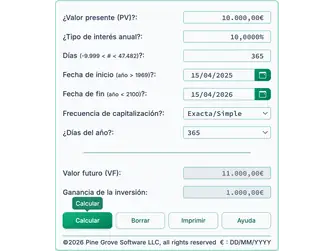
The Accurate Future Value Calculator answers the question, “What will be the value of an amount at some future date, assuming “X” rate of return?” This calculator allows you to select any start and ending date.
Dos factores afectan al VF del dólar (y al VF de cualquier otra moneda):
- Inflación (o deflación)
- Tasa de rendimiento de la inversión
Cuanto mayor sea la tasa de inflación, menos comprará el dólar. Cuanto mayor sea la tasa de rendimiento de la inversión (o tasa de interés)— o mayor sea la tasa de deflación—, más comprará el dólar.
Esta calculadora de valor futuro calcula el VF de una cantidad o activo después de un número exacto de días. Soporta cualquier tasa de rendimiento (probada hasta el 99% por año) para 12 frecuencias de capitalización, más interés simple.
Debido a que esta calculadora es sensible a la fecha y soporta múltiples opciones de capitalización, es adecuada para calcular el saldo de una deuda si el deudor no ha realizado pagos. Más detalles aparecen debajo de la calculadora…
La Calculadora‑Calcule el valor futuro de una cantidad
Información
Más sobre el valor futuro
La calculadora de valor futuro normalmente calcula un valor nominal. Esto significa que la cantidad calculada refleja ganancias de inversión o intereses obtenidos sobre el dinero. Un valor futuro nominal no refleja el efecto de la inflación.
Si desea conocer el valor futuro real, puede calcularlo de una de dos maneras.
¿Cómo afecta la inflación al valor futuro?
Si desea conocer el poder adquisitivo del importe original después de la inflación, reste una tasa de inflación estimada a la tasa de interés anual. Por ejemplo, si su tasa de interés anual es del 4,5 % por año y estima que la inflación promediará el 2 % por año, entonces, en lugar de introducir el 4,5% como su tasa de rendimiento, debería introducir el 2,5%. El valor futuro calculado representará el valor futuro real.

Esta terminología puede ser engañosa. Los economistas llaman a esto valor futuro real, pero es solo un valor futuro real estimado porque sólo podemos estimar la tasa futura de inflación.
Sin embargo, el valor futuro real es una medida más precisa que el valor futuro nominal, que no tiene en cuenta la inflación.
Si desea compensar explícitamente la inflación, añada la tasa de inflación a la tasa de interés anual. Por ejemplo, si alguien le debe 2.000 € durante 5,5 años y acordó compensarle con un 2 % de inflación además de una tasa de interés del 4 %, entonces añadiría la tasa de inflación a la tasa de rendimiento.
El resultado refleja el efecto de la inflación. Otra forma de expresarlo es: si un inversor quiere obtener una rentabilidad real del 4,5 % en una inversión, ¿cuánto debe ganar también para compensar la pérdida de valor por inflación?
La calculadora de valor futuro hace que todos estos cálculos sean sencillos.
Ecuaciones del valor futuro
En esta sección:
Ecuación del valor futuro – Interés compuesto diario
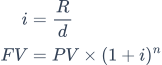
Variables: PV = 10.000; R = 10 %; d = 365; n = 730.
Definiciones de variables
- R
- Tipo de interés anual nominal.
- d
- Días en un año, típicamente 360 o 365.
- i
- Tasa de interés diaria.
- PV
- Valor presente — el importe del capital (inversión inicial).
- n
- Número de días del plazo.
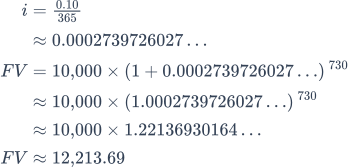
Pasos de cálculo explicados – Fig. 2
- ¿Cuál es el valor futuro de 10.000 € invertidos durante dos años con capitalización diaria a una tasa de interés anual del 10 %?
Para calcular el valor futuro (FV) de una inversión con capitalización diaria, utilice la fórmula
FV = PV × (1 + i)n, dondei = R ÷ dynes el número de días del plazo:- Calcule la tasa de interés diaria:
i = 0.10 ÷ 365 ≈ 0.0002739726027…. - Sustituya los valores en la fórmula:
FV = 10.000 × (1 + 0.0002739726027…)730. - Simplifique la base:
1 + 0.0002739726027… ≈ 1.0002739726027…. - Eleve la base a la potencia 730:
(1.0002739726027…)730 ≈ 1.22136930164…. - Multiplique por el capital:
10.000 × 1.22136930164… ≈ 12.213,69.
La inversión crece a 12.213,69 € después de dos años de capitalización diaria a una tasa de interés anual del 10 %.
- Calcule la tasa de interés diaria:
Solución paso a paso – Fig. 2
i = 0.10 ÷ 365 ≈ 0.0002739726027…FV = 10.000 × (1 + 0.0002739726027…)730≈ 10.000 × (1.0002739726027…)730≈ 10.000 × 1.22136930164…≈ 12.213,69
Respuesta final
La respuesta final (FV) es aproximadamente 12.213,69 €, de los cuales 2.213,69 € son intereses (I).
Validar la calculadora. Interés compuesto diario a dos años.
| Valor presente (PV): | 10.000,00 € |
|---|---|
| Tasa de interés anual: | 10,0 % |
| Días: | <calculado> |
| Fecha de inicio: | |
| Fecha de fin: | |
| Frecuencia de capitalización: | Diario |
| Días en un año: | 365 |
| Valor futuro (VF): | = 12.213,69 € |
| Ganancia de la inversión (interés ganado): | 2.213,69 € |
Notas:
- Este ejemplo utiliza el mismo cálculo que se muestra en la Fig. 2.
- Para la capitalización diaria, la calculadora siempre usa días como unidad de tiempo al calcular el plazo (n).
- Puede introducir dos fechas que estén exactamente a dos años de distancia (la calculadora determinará el número de días), o—
- Introduzca un número específico de días (p. ej., 365 o 366 si el 29 de febrero está incluido), y la calculadora determinará la fecha de fin.
Valor futuro – Interés simple diario
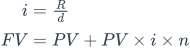
Variables: PV = 10.000; R = 10 %; d = 365; n = 730 (dos años).
Definiciones de variables
- R
- Tipo de interés anual nominal.
- d
- Número de días en un año (comúnmente 360 o 365).
- i
- Tasa de interés diaria.
- PV
- Valor presente — el importe del capital (inversión inicial).
- n
- Número de días en el plazo de la inversión.
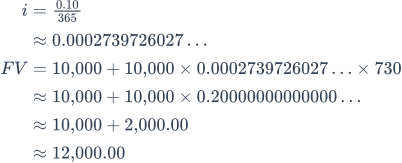
Pasos de cálculo explicados – Fig. 4
- ¿Cuál es el valor futuro de una inversión de 10.000 € invertida durante dos años con interés simple a una tasa de interés anual del 10 %?
Para calcular el valor futuro (VF) de esta inversión bajo interés simple diario, use la fórmula
FV = PV + PV × i × n, dondei = R ÷ dynes el número de días del plazo. Los pasos son:- Calcule la tasa de interés diaria:
i = 0.10 ÷ 365 ≈ 0.0002739726027…. - Sustituya los valores conocidos en la fórmula:
FV = 10.000 + 10.000 × 0,0002739726027… × 730. - Multiplique la tasa diaria por el número de días:
0,0002739726027… × 730 ≈ 0,20000000000000…. - Multiplique ese resultado por el capital:
10.000 × 0,20000000000000… ≈ 2.000,00. - Sume el interés al capital original:
10.000 + 2.000,00 ≈ 12.000,00.
La inversión crece a 12.000,00 € después de dos años de interés simple diario a una tasa de interés anual del 10 %.
- Calcule la tasa de interés diaria:
Solución paso a paso – Fig. 4
i = 0.10 ÷ 365 ≈ 0.0002739726027…FV = 10,000 + 10,000 × 0.0002739726027… × 730≈ 10,000 + 10,000 × 0.20000000000000…≈ 10,000 + 2,000.00FV ≈ 12,000.00
Respuesta final
La respuesta final (VF) es aproximadamente 12.000,00 €, de los cuales 2.000,00 € es interés.
Valide la calculadora. Interés compuesto mensualmente durante un año.
| Valor presente (PV): | 10.000,00 € |
|---|---|
| Tasa de interés anual: | 10,0 % |
| Número de días: | <calculado> |
| Fecha de inicio: | |
| Fecha de fin: | |
| Frecuencia de capitalización: | Exacto ÷ Simple |
| Días en un año: | 365 |
| Valor futuro (VF): | 12.000,00 € |
| Interés total (ganancia): | 2.000,00 € |
Notas:
- Este ejemplo utiliza el mismo cálculo que se muestra en la Fig. 4.
- Para el interés simple, la calculadora siempre mide el tiempo en días.
- Puede introducir dos fechas exactamente a dos años de diferencia (la calculadora calculará el número de días), o—