
Accurate Mortgage Calculator
How do I use the mortgage calculator?
- Enter the Price of Real Estate.
- Enter the Down Payment Percent or the Down Payment Amount.
- Set Mortgage Loan Amount to 0 if the amount is unknown.
- Enter the expected Number of Payments.
- Enter the anticipated Annual Mortgage Interest Rate.
- Set Mortgage Payment (P & I only) to 0 if the amount is unknown.
- Optionally, set the Mortgage Closing Date.
- Optionally, set the First Payment Due Date.
- Optionally, enter Points.
- Click either Calc or Pmt & Cost Schedules to see the results.
These steps are sufficient to calculate a fixed-rate mortgage payment.
However, the calculator can also provide additional information beyond the payment amount.
Details are below…
The Calculator-Calculate Down Payment, Payment, PMI, Rate and Term
Information
IMPORTANT — Always enter (and reenter) 0 when you want the calculator to compute a value.
Why does the calculator not automatically calculate the last unknown value?
The calculator creates a payment schedule based on the exact parameters you choose. This behavior is intentional.
By not automatically recalculating the payment when the mortgage amount changes, the calculator allows users to create a schedule with any payment amount they select. If you provide the payment amount, you will usually set the “Number of Payments” to “0.”
Notes about this calculator
Found on the “Set Dates or XPmts” tab:
- Mortgage Closing Date — also called the loan origination date or start date.
- First Payment Due — the due date for the first payment.
About Dates & Interest Calculations — In practice, the time between the mortgage origination date and the first payment due date is rarely equal to the payment frequency.
Your mortgage may require monthly payments, but you might close on July 15 and have the first payment due September 1. This results in a “long initial period” and “odd days interest.” (If the first payment were due August 1, the first period would be an “initial short period.”)
Long and short first periods affect interest and payment calculations.
Because you can enter these two dates, the calculator can produce penny-perfect calculations.
This may result in payment amounts and interest charges that do not match other calculators.
That is intentional. You do not need to rely on estimates.
If you prefer approximations, or if you want to match other calculators, set the “Mortgage Closing Date” and “First Payment Date” so the time between them equals one full period as selected in “Payment Frequency.” Example: If the “Mortgage Date” is July 15 and the “Payment Frequency” is “Monthly,” then the “First Payment Date” should be August 15.
More details about the available calculation options for odd-day and irregular-period interest.
There are only six values you will usually need to set.
Found on the “Calculator” tab:
- Price of Real Estate or Asset — the negotiated purchase price. This is optional. Enter a zero to calculate.
- Down Payment Percent — the anticipated down payment expressed as a percent of the purchase price. (optional)
- Down Payment Amount — the anticipated down payment expressed as an amount. (optional)
- Mortgage Loan Amount — the amount of the mortgage loan. This is also optional. Enter a zero to calculate.
You may:
- Enter the real estate price and the down payment to calculate the mortgage amount.
- Enter the mortgage amount and down payment to calculate the affordable real estate amount.
- Enter the mortgage amount and zero for both the down payment and the price.
- Number of Payments — the length of the loan. The “Payment Frequency” setting also affects the loan term. For a thirty-year term, if the payment frequency is monthly, enter 360 for the number of payments. (360 monthly payments = 30-year mortgage)
- Annual Interest Rate — the nominal mortgage rate. This is the quoted interest rate for the mortgage. As of July 2025, the average rate in the U.S. was 6.72% according to the St. Louis Fed.
- Mortgage Payment (P & I only) — the amount due on each payment due date. The amount includes only principal and interest. Do not include any additional amounts for property taxes or insurance premiums if you enter a value.
If the Mortgage Loan Amount is either set or calculated from the real estate price, then one of the above three can be set to zero so the calculator can calculate it.

Mortgage options you may want to adjust:
- Payment Frequency — set how often payments are scheduled. The calculator supports 11 options, including biweekly (every other week), monthly, and annually. The schedule calculates the payment due dates from the first payment due date (not the mortgage closing date).
- Compounding — usually, you should set the compounding frequency to the same frequency as the payment frequency. Doing so results in simple, periodic interest. Setting this option to “Exact/Simple” results in simple, exact-day interest.
- Days-Per-Year — 360/364/365 days-per-year option. This setting, also known as the day count convention, affects interest calculations only when you set the compounding frequency to a day-based frequency (daily, exact/simple, or continuous) or when there are odd days caused by an initial short or long period.
- Calc. & Include APR on Schedule — when “Yes,” the mortgage schedule shows the APR in a Regulation Z-compliant format.
Found on the “Options” tab:
- Points — sometimes called discount points. Calculated using the loan amount, they are reported in the first row of the schedule. One point is one percent of the mortgage loan amount. Points, by themselves, increase the APR. Borrowers pay mortgage points to obtain a lower interest rate. The combination of points and the lower rate should result in an overall lower APR. Check the APR option to verify. (optional)
Mortgage amortization schedule
We learn from the financial dictionary that mortgage amortization “is the gradual repayment of a debt over a period of time, such as monthly payments on a mortgage loan or credit card balance. To amortize a mortgage, your payments must be large enough to pay not only the interest that has accrued but also to reduce the principal you owe.”
A mortgage amortization schedule is a report showing the loan payments paid or due. The report provides details about how much of each payment the lender allocates to principal and interest. The payment due date and the balance are frequently included in the schedule as well.

If the amount paid on the mortgage is not large enough to cover the interest due, then the mortgage balance will increase because of the unpaid interest. When a loan has an increasing balance, it is known as negative amortization — which this calculator supports. (Read more about negative amortization here.)
Options that impact the payment report
Found on the “Set Dates or XPmts” tab:
- Amortization Method — leave this setting at “normal” unless you have a specific reason to change it. For a complete explanation of these options, see Nine Loan Amortization Methods.
- Days-Per-Year — see above.
- Fiscal Year-End for Report Totals — this setting determines after which month the calculator shows year-end and running totals. This option accommodates businesses with fiscal years that do not align with the calendar year-end.
- Rounding Options — because of interest and payment rounding with each payment (for example, a calculation might produce 345.0457, but the schedule must round to 345.05), almost all loan schedules require a final rounding adjustment to bring the balance to “0.” A footnote on the payment schedule shows the rounding amount.
How do I calculate a mortgage payment schedule with a balloon?
Because the mortgage calculator uses the values you enter (and does not force a recalculation), it is straightforward to create a mortgage payment schedule with a final balloon payment. For example:
- Assume a mortgage of $400,000.
- Assume a payment amount based on a 30-year term.
- Assume an annual interest rate of 3.0%.
- The monthly principal-and-interest payment is $1,686.42.
- If the balloon payment is due in 5 years, change the number of payments to 60.
- Click the “Amortization & Cost Schedules” button.
- The 60th payment shows a balloon due of $357,311.

Mortgage with PMI and taxes
If you do not have a down payment that equals at least 20% of the home’s purchase price, the mortgage issuer will likely require you to pay mortgage insurance. PMI (private mortgage insurance) protects the lender in the event of a default. The lender gets paid when the borrower cannot pay.
Although the lender collects on the insurance if there is a default, the borrower pays the insurance premium. The insurance amount depends on the size of the mortgage and the down payment. The larger the mortgage and the smaller the down payment, the higher the PMI rate. PMI rates range from 0.5% to 1.5%.
The annual PMI premium equals the PMI rate from the tables multiplied by the loan amount. The PMI premium is collected monthly, so the calculator divides the premium by 12 (or by the number of payments per year) to calculate the monthly premium due.
You can look up PMI rates in each provider’s rate tables. However, the rate tables will not ask for the down payment amount. The tables use a value called your LTV. LTV, or loan to value, is the ratio of the mortgage loan amount to the price of the property.
If the house sells for $400,000 and you put down $40,000, leaving a loan balance of 360,000, your LTV is 90% (360,000/400,000). This calculator calculates the LTV for you.

While PMI increases the borrower’s cost, you do not need to pay PMI premiums for the entire mortgage term. Once you have built sufficient equity and your LTV drops below 80%, PMI premiums stop. See SFGate’s guide for additional details.
The payment schedule created by this calculator will show you when the PMI premiums stop.
Mortgage with extra payments
The calculator supports schedules with:
- a specific number of additional payments; or
- extra payments until you have paid off the loan; or
- extra payments at a different frequency than the “regular payment” — for example, two extra payments per year; or
- additional payments on dates other than a scheduled date; or
- a single lump-sum extra payment on any date

Review the mortgage payment schedule. Look at the lines where you made an extra payment. One hundred percent of each extra amount applies to the principal balance. If you are auditing your lender, they must apply your extra payments in the same manner to maximize your interest savings. Some lenders may not do this, particularly when the extra payment occurs on a date other than a scheduled due date.
Many online calculators also fail to make this calculation correctly. That is why this calculator is the real deal.
Hopefully, you will find this to be a full-featured mortgage calculator. If anything is not clear, you may leave your question in the comments below.
Walter Rosenblum says:
Love your loan calculator. I have a client that has taken on a lot of debt while attempting to start his business. Your amortization schedules are great and the program is fun and easy. Question, how do you handle a balloon payment at the end of the loan?
Karl says:
I’m happy to hear that you are finding the calculator useful.
There are several options for a balloon loan. The easiest way is to just enter the balloon term and the regular monthly payment that has been agreed upon. For example, calculate the payment based on say 360 months, then set the number of payments to the term of the balloon, say 60 payments, and then view the amortization schedule.
Does this help? If not let me know what’s not quite right and I’m sure we can resolve it.
Tony says:
Very detailed and helpful calculators! I would love to see an option for an XLS download. I cannot get Excel or Sheets to open XML files, even using the XML import function. (I’m not an advanced Excel user, so I’m sure this is why, but an XLS option would be super helpful).
Karl says:
Thank you. I’ve looked at adding .XLS support, but the amount of code that I would have to add causes the calculator to load slower. Also, it’s not clear to me what folks would expect if this calculator did save to .XLS. Would they expect just the data? Should it be formatted with fancy formatting? Or just columns and rows of data? Do they expect the calculations to continue working? Lots of questions.
Tony says:
Thanks for the reply. In my case, it would just be helpful to have the data presented in a readable format, so just columns and rows. I would not need the calculations to function or any special formatting, just an organized format in rows and columns so that I could then format the data as needed. Even CSV or another format that would be able to import easily into Excel so that the data is readable. Thanks again for all of your work on these calculators! Very impressive.
Karl says:
You’re welcome. I may have a basic XLS export added in the future. But there are other features ahead of that. Perhaps for 2022?
Alan Taylor says:
No matter what I do, I can’t open an XML file. Why won’t this just save to Excel?
Karl says:
I’m using Excel 2010 (yes, old I know, but I doubt if Excel has eliminated the feature).
I click on "File" and then "Open." To the right of "File name", I’m given the opportunity to pick file type. One of the types is "XML file (*.xml)."
Did you try making that selection, and then picking the file you saved from the calculator?
The XML file contains your inputs, and not the schedule. If you want the schedule in Excel, do a copy/paste. You’ll probably need to use Excel’s "Paste special" feature, and do a paste as text.
Eddie says:
I need to make multiple unscheduled and unknown frequency principal reduction payments to the original amortization schedule. Explained another way: The original loan amount can be reduced if borrower chooses to make individual and unscheduled principal reduction payments. When those occur, I need to rerun the amortization schedule showing past “xtra pmts” made and the current “xtra pmt”. Those payments reducing the term of the loan. Payment amount is constant. I am only able to accomplish one “xtra pmt” presently. Possibly I am overlooking a feature you have already built into the schedule. By the way this is an excellent tool and has helped me on several occasions. Thank you.
Karl says:
I’m happy to hear that you’ve found this calculator useful.
For what you want to do, you’ll need to use this loan payment tracking calculator. It should have all the flexibility that you need.
Bruce Arnold says:
I am trying to calculate a mortgage payoff with 2 payments annually on Aug 1 and Sept 1 each year, with mostly late payments and some missing payments. Cannot see anywhere to accomplish this. Am I missing something? Is there anyway to enter these actual irregular payments rather than the payments as they were supposed to have been. I suspect it is all manual entry. Will this calculator do that?
Karl says:
Please use this loan payoff calculator. It will handle late and missed payments as well as payments made on any date.
Monica Ambs says:
I have used your calculator since January of 2021. Recently you have changed an awful lot of calculators on this page. The mortgage calculator with extra payments does not seem to work for weekly payments, daily interest. Why is that? And no matter how many times I choose daily interest and weekly payments, it defaults automatically to monthly payments and compound interest. Why is that?
Karl says:
Thank you for using the these calculators!
Nothing should have changed with regards to either payment frequency or compounding.
I’ll make a guess – you’ve set the calculation method to ‘Canadian’? Canadian forces semiannual compounding and monthly payments, and that’s all it does.
If that’s what is going on, change calculation method to ‘normal’ and all should be good.
Please le me know if this fixes the problem. If not, please tell me all settings (you can save them to a file and email them to me).
Mici says:
hello, before I was very grateful for this mortgage calculator. it’s very usefull! but in my case, initially this calculator since I installed it on my website runs smoothly and perfectly. but now there is something like a bug that I don’t know the cause so that the currency option cannot be set according to the desired currency. previously it could appear a pop up menu to select the currency. but now it can’t appear. please help, I would be very grateful! best regards!
Karl says:
Please provide a URL to the page where you have installed the plugin so that I can take a look.
Thank you.
mici says:
here’s the URL
Here is the url, https://perumahanajisaka.com/informasi-kpr/
thank you!
mici says:
https://perumahanajisaka.com/informasi-kpr/
here’s the url, thanks for the reply!
Karl says:
Thank you for the link. I see what you mean, and I see that the problem now exists on my site too.
I don’t have a solution for you right now. I will look into this bug to understand the cause, but I don’t have a timeframe just yet as to when I can do this.
Karl says:
Also, if you expect all your visitors to be using the same currency, you as the site owner can set the currency option to be anyone you need.
This is mentioned in the documentation. Let me know if you need help if that’s a viable option for you.
In fact, it might be even a better choice rather than making your visitors change the currency.
mici says:
thank you for the solution, very helpful! but if I want to change the currency rule with the sc_currency= setting, to change it to rupiah what code should I use?
mici says:
is it [fcmortgageplugin sc_currency="84"] or what?
and if i want to change the currency and date default to rupiah and DD/MM/YYY , what should i do, thank you
Karl says:
In the root of the plugin’s folder (<your WordPress theme folder>plugins\fc-mortgage-calculator), please find this file:
currency_and_date_conventions.txt
all the date and currency options are documented there.
Karl says:
Please try the new Plus version of the mortgage plugin. It also allows your users to print. 🙂
smurphy says:
Loan is principal only payments for first two years, with interest to accumulate at a set interest rate. Then interest is added to loan balance after deducting the first two years principal payments and there will be a principal paydown. New loan balance will be paid on adjusted interest rate with standard amortization (interest and principal). Help? Can’t seem to find the best calculator(s) to utilize.
Karl says:
You will have to use the Ultimate Financial Calculator.
This is a summary of what you’ll have to do.
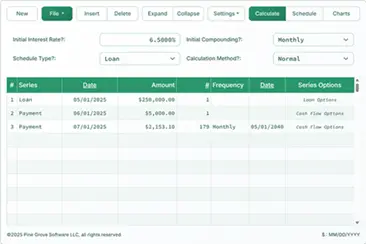
1. Enter the interest rate at the top of the calculator.
2. In the first row, enter the loan amount. Let’s say that 500,000.
3. If the first 24 months are principal only payments, you’ll have to use a calculator to calculate what the principal will be. If the loan has a total term of 180 months, then using 500,000 divide that by 180, and you’ll get 2777.78 as the monthly payment amount.
4. Enter 2777.78 in the second row, and set under # 24 and set frequency to montly. Click on “Cash Flow Options”. In the Window that opens, click on “Principal First.” You should see 2777.78 there. Now click on “Activate ‘Principal First’ payment for currently selected series’. (Important! This tell the calculator to only apply the payment to principal for the 24 months.) Save your changes to close that window.
5. In the 3rd row, for payment amount enter “Unknow” (just type “U”). And the number of payments (again, using my example) will be 156 (180-24=156).
6. Click calculate.
7. Click Schedule.
You will see a schedule with the first 24 payments as principal. You also see the interest balance, but no intererst paid.
If you have any questions, please feel free to ask.
smurphy says:
Thank you so much, Karl. The one question I have after reading your instructions is if it will let us input the amount of principal, since the parties have agreed on a set monthly payment for the first two years.
I should probably take a toutorial for that calculator, but normally I use the more basic ones.
You are awesome! thanks again.
Karl says:
Sure. So instead of using the calculator as I told you to do in step 3, enter the number agreed upon.
Peter Nyiri says:
I need a mortgage calculator/loan calculator with extra payments (in Hungarian). For some reason the extra payments tabs are not present in the WP plugin version. What can I do?
Karl says:
Did you just leave a message on the WordPress forums? I replied there.
The plugin comes with all the source code, you or your developer can add an extra payment feature.
The mortgage calculator on this site is not a plugin.