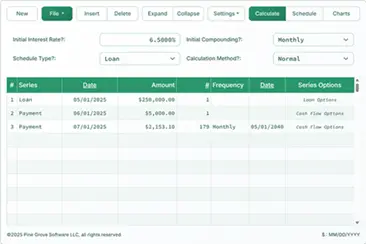
Accurate Extra Payment Calculator
Why should I make an “extra” loan payment?

Extra payment calculator calculates interest savings due to a lump sum or multiple extra payments.
- Creates printable payment schedule with dates
- Calculates total interest savings
- New: Export to XLSX/DOCX files
- Is it better to make extra payments or otherwise invest the money?
- Supports single or multiple extra payments
If you pay an extra amount in addition to your scheduled payment, you will save interest, and the loan will be paid in full sooner.
If I make extra payments, how much interest will I save?
The amount you will save depends on the current balance, the loan’s interest rate, the date you start making extra payments, and the additional payment amount. Use an extra payment calculator to calculate the exact savings.
In some cases, usually for longer-term loans such as mortgages, the savings in interest charges can be very large. If the borrower starts making the extra payments early enough, and for an amount that’s not exceptionally large, it is possible to save tens of thousands of dollars on a $200,000 mortgage (the average new mortgage balance as of February 2022 was $453,000, according to CNBC).
Specifically, for a mortgage that is smaller than the average, if the borrower makes an extra $200 payment each month, the borrower will save more than $50,000, assuming a 30-year loan and a 4.25% interest rate.
How is this possible? What explains this result?
There is no trick. The future savings are a mathematical certainty. They result from the way loans and mortgages work. The periodic interest amount is calculated by multiplying the loan’s current balance by the periodic interest rate—the lower the balance, the lower the interest amount due.
Therefore, when you prepay principal (make extra payments), you reduce the loan balance used to calculate the interest due.
This result is a mathematical certainty, and this calculator will show you exactly how much interest you will save on any loan and when the loan will be paid off.
Consider the impact of paying off a 30-year mortgage in 20 years. More below…
The Calculator-Calculate Savings Due to Making Extra Principal Payments
Information
This result can seem very attractive.
It does.
However, “How much will I save if I make extra principal payments?” is not the question you should focus on.
Is it a good idea to make additional payments?
You will save interest by making extra payments. However, you should also consider how much you could earn if you invested the funds instead. Some extra payment calculators perform this comparison calculation.
If you have $200 and use it to make a prepayment toward a loan, you cannot also use the same $200 for investing. Economists call this a foregone opportunity. The opportunity to do something else with that same $200 will not return.
How can you determine which decision is better?
Use this calculator to make the comparison.
The calculator uses your Your Investment Rate-of-Return value and calculates the future value of all the projected extra payments. It then calculates the investment gain and subtracts it from the Total Interest Saved to arrive at the net gain from the extra payments (the value shown as Interest Saved Less Investment Gain).
Consider the following example.
When you open this page, you will see the calculator preloaded with a $260,386 loan or mortgage, and $200 per month as the default prepayment amount.
For the investment rate of return, the calculator uses a default of 7.2%, which is the approximate average rate of return for the S&P 500 according to this analysis, which is somewhat dated. The analysis is dated. However, considering stock market performance since that study, a 7% assumption for deciding whether to make extra payments on a loan is conservative.
You may use any rate of return you consider appropriate.
Using these default values, the results are as follows:

There are $52,829 in interest savings, and the mortgage that would normally require 360 payments will be paid off after 276 payments.
However, the investment result is even more significant.
If the borrower invests $200 per month, then after 276 months, the investment gain will be $81,238. The total value of the investment account will be $55,000 in extra payments invested plus the $81,238 gain, which equals $136,238.
This example shows that while a $52,000 interest savings is significant, an $81,000 investment gain is greater.
How much greater is this gain?
The difference is $28,409, as shown in the final result labeled Interest Saved less Investment Gain ($52,929 - $81,239).
If, after entering your own numbers, you also get a negative result, then you should consider not making extra payments. At least in theory, you would earn more from your investments than you would save in interest charges.
Want to confirm the results?
Select the “Supporting Schedules” button. There you will find all the supporting numbers used in the analysis above. You will see a detailed amortization report that lists the periodic payment, the interest charges, and the extra payments applied to the principal balance.
After the loan payment schedule, you will see a future value (investment) schedule. This schedule shows the capital gain from the invested extra payments.

When might it make sense to continue making extra principal payments even when the calculator indicates that investing could be the better option?
There are at least two situations in which you may decide not to invest the prepayment funds.
One reason is simple—risk.
Earlier, when explaining why prepaid principal reduces costs, I referred to a “mathematical certainty.” If the borrower makes the extra payments as planned, the interest savings are guaranteed. The lender can charge interest only on the outstanding balance.
By contrast, if you invest, even on schedule and in the intended amounts, the return is not guaranteed (although some investments may offer guaranteed returns). At the end of the loan term, you may not have the capital gains you expected. You could also have a larger gain than expected.
That uncertainty is the risk.
The second reason is the desire to live without debt. A borrower who takes out a 30-year mortgage may want to be debt free in 20 years. That motivation is understandable. I felt the same way, and I followed that approach—before creating this calculator.
However, it is possible to become debt free early while also following an investment strategy instead of a principal prepayment strategy. These choices are not mutually exclusive.
Here is the step-by-step explanation:


- Review the example the calculator loads when you first open the page (reload your browser to reset the values). As of this writing, the final payment is scheduled for March 1, 2046. Note this as the debt-free date with extra payments.
- Set the extra payments to 0 and review the schedule. This schedule shows no additional payments. Find the balance as of the debt-free date. As of this writing, the balance is $92,929.
- Reenter the extra $200 payment amount and review the investment schedule that follows the loan schedule. (The calculator creates an investment schedule only when an extra payment amount is entered and the option “Include the Investment Schedule?:” is set to “Yes.”)
- With prepaid principal payments, the loan is paid off in 276 payments, or 23 years.
- On March 1, 2046, the investment account balance is $136,238.
- You can pay off the mortgage using the investment account, become debt free on the planned date, and still have nearly $40,000 remaining.
There is an important consideration.
This analysis does not include taxes. In the U.S., some interest may be deductible (although this is less certain than in the past). Investment gains may also be taxable, which reduces the illustrated gain.
However, taxes are not always unavoidable. Tax-free bonds generate tax-free income (although results may be lower). If you invest and do not sell, the gain compounds without current tax. Tax is paid only when you sell, and long-term capital gains rates are often favorable.
These tax issues are important to evaluate. Adding every tax scenario to the calculator would create complexity and confusion for most users.
The Calculator’s Features
Your situation may differ from this example. Use the Extra Payment Calculator to see how much you can save and when your loans will be paid off.
Here are several additional features the calculator supports.
If you do not plan to make extra payments monthly, the calculator allows you to choose from 11 payment frequencies, independent of the regular payment schedule.
If you receive an annual bonus and want to apply it to principal, the calculator will still compute your savings. You can schedule one or two extra payments per year.
If you want to make a single extra payment, the calculator supports a one-time payment on any date during the loan term. For example, you might receive an inheritance and decide to reduce the principal. The calculator will show your interest savings and your new payoff date.
Be sure to review the printable schedule for full details.
The loan itself does not have to follow a monthly schedule. The final option on the Extra Payment tab allows you to select any payment frequency.
This Calculator Is Not Only for New Loans
The calculator is not limited to new loans. If you have been paying a loan for several years and have received a raise, you can analyze extra payments on the existing loan. Enter the following four inputs:
- The loan balance as of the last payment due date.
- The number of payments remaining.
- The loan’s interest rate.
- The regular payment amount.
The calculator will use your loan’s terms in the analysis.
There is also one important setting. On the “Extra Payments/Investment Rate” tab, review “Is a Regular Payment Due Today?:” The default is “No.” If you enter a balance as of a payment due date, set this to “Yes” to prevent the calculator from adding accrued interest.
If this detail is unclear, do not worry. The difference is usually small.
Don’t Forget the Charts
Schedules contain many figures and can be difficult to review. If you prefer visual summaries, the calculator automatically creates nine charts.

- Annual Totals without Extra Payments
- Annual Totals with Extra Payments
- Annual Investment Plus the Annual Gain
- Accumulated Totals without Extra Payments—running totals since the loan’s origination
- Accumulated Totals with Extra Payments
- Accumulated Investments Plus the Total Gain—year-over-year growth and final value
- Pie Chart: Loan Payment Total Allocated to Principal and Interest
- Pie Chart: Loan Payment Total Allocated to Principal and Interest with Extra Payments
- Pie Chart: Investments and the Gain on Investments
Wrapping Up
When you searched for an extra payment calculator, you likely wanted to know how much interest you could save. You may not have expected this many considerations.
The payment is not truly “extra.” The money is owed. The borrower must pay. When people say “extra payment,” they usually mean an additional principal payment. The distinction is minor, but useful.
You do not need to review everything at once. Return as needed and test different scenarios.
Regardless of your choice, the calculator helps you make an informed decision.
If you wish, share the approach you plan to take and whether the calculator was helpful. Suggestions for improvement are welcome.
Use the comments section below.
Extra Payment Calculator Help
The accelerated payment calculator shows the impact of making extra principal payments. A small extra principal payment made with each regular payment can save a borrower a significant amount of interest over the life of a loan, especially when the debt is relatively new.
For example, assume you borrow $130,000 for 360 monthly payments with an annual interest rate of 7 3/4%. If, beginning with the 49th payment, you add an extra $225, you will save $75,901.42 in interest, and the loan will be paid off in 234 payments instead of 360.
This calculator makes it easy to evaluate many scenarios. Generally, the higher the interest rate, the greater the savings from any extra payment. For a standard amortizing loan, savings are also larger when extra payments begin earlier. For example, you will save more interest by paying an extra $50 per month for the last 20 years than by paying an extra $100 per month for the final 10 years.
Like many of our calculators, this calculator can also solve for an unknown value. For example, if you want it to calculate the regular monthly payment, enter 0 for “Periodic Payment” and enter nonzero values for “Amount of Loan,” “Total Months,” and “Annual Interest Rate.”
If you do not enter 0, the calculator will use the payment amount you provide. This lets you test any payment amount you prefer.
Monica Ambs says:
I have a weekly mortgage payment that comes out every Friday and I contribute an extra $1250.00 per month on the first. When I use the Accurate Extra Payment Calculator it defaults the weekly regular payment to Saturday every single time. How do I get the calculator to post the payment on the Friday of each week.
Karl says:
First, to answer your question, Monica, you’ll need to use the Ultimate Financial Calculator to be able to show the payments on Friday.
If you try the UFC, scroll down the page to the tutorials. There are two about extra payments. Also, the first tutorial is about setting up a loan calculation.
On the other hand, generally when someone is looking at the impact of extra payments, since the calculation is a forward looking calculation, and it is doubtful that someone is going to make every payment on the exact date projected, whether you have a schedule with the payments on Friday or Saturday is not going to make a material difference in the result. What I’m trying to suggest is, it may not be worth the effort required to set your calculation up using the UFC. But if you have any questions, just ask.
Pam Jaquish says:
Hi, I’ve been using your charts for years but this time when I use the extra payment calculator, I put in the 180 payments for a 15 year mortgage, when I print it, it changes it to 250 months. What am I doing wrong? Also, if I only use the Ultimate, and extra payment, can you think of a reason I may need a yearly subscription for anything else. I am managing my own rentals and mortgages,but haven’t had to do these in a while. Plan on selling a lot of my rentals for mortgages, so any advice on the forms I may need to get these people to closing would greatly help. I took over this from my husband upon his death and tired of dealing with all of the work at my age. Thanks in advance. Pam
Karl says:
Hi Pam, First, if you are tracking payments, the only calculator you should need to use is the Ultimate Financial Calculator. It will also handle extra payments.
As to your question about the number of payments changing, I would need you too document all your inputs and settings. Tell me what you are trying to solve for.
pjake says:
Good Morning, Karl,
Well, I am on a deadline for my attorney and I tried again to use the Extra payment calculator, I like that one usually much better, for what I need than the ultimate, which I don’t really understand. The amortization calculator is what I usually use when I have done a closing and starting from scratch, but when I am having to figure out and figure UP what a client has done I need the extra payment calculator and it works perfectly except that when it asks the number of payments that the person has paid with this extra payment, I put in the 68 payments out of 180 (his original mortgage) and he has paid 68 months at .38 more. That is all, but it is enough to mess me up. His payments should have been 350.62 and he pays $351.00 every month. I am trying to figure up how much principal and how much interest as in your amortization calculator, but when it asks how many payments he has paid this paltry little extra amount, I put in the 68 months he has paid and it changes the original length of the mortgage from 180 to 248 (adding the 68 monthly payments to the original 180 months of the mortgage). Is there a calculator that will do this for me? I thought I remembered you had one originally that figured it the correct way without changing the amount of months he is to pay. As I said, I do not really get the Ultimate calculator. My favorite is the simple amortization and I use it about 98% of the time unless someone throws a monkey wrench in the works like this fella. Any advice you can give me would be appreciated. I am supposed to get this to him today.
Pam
Karl says:
Use the amortization schedule, but instead of having it calculate the payment amount, enter the payment amount he is actually paying. Set the number of payments to 0, so the calculator calculates the term based on the actual payment.
The thing with using the amortization schedule for this, is you can’t change the dates. It will assume all payments are made on the scheduled date. The UFC will let you change dates.
As to the UFC, did you read any of the tutorials? Did you watch any of the videos? If something is not clear, it would be better for you to say what that is, rather than “I do not really get…” if you want assistance in understanding the calculator.
alaberge says:
Does AccurateCalculators.com have a ONE TIME prepayment comparison tool to compare (1) reducing remaining installments of principal in “inverse order of maturity” beginning with the final installment and working backward from there to (2) reducing such installments in “forward order of maturity” beginning with the next installment that is due? I think the first method benefits the borrower and the second benefits the lender, and I’d like to assess the different in interest savings between the two. By “one time,” I mean, for example, a one-time $100K payment at some point on a ten-year $800K loan. Thanks.
Karl says:
The Extra Payment Calculator you are using allows you to make single extra payments on any date.
However, what you describe is not how amortization works. On the day a payment is made, the loan balance after the last payment is used for calculating interest due until the current payment date. The interest is added to the balance, and the payment is deducted. If an “extra” principal payment is paid, the balance is adjusted accordingly. There’s no reducing the “remaining installments of the principal.” The principal is reduced once, when the payment is made.
alaberge says:
Okay, thank you, I see that it allows for just one extra payment. The current loan I am working with provides for quarterly payments. The extra loan calculator seems to be limited to months in regard to “number of payments remaining.” Is that the case? Also, just to confirm, there isn’t a calculator for prepayments in “inverse order of maturity,” correct? This is a relatively standard clause in loan agreements but probably not the main type for mortgage loans. In any case, wouldn’t it kind of be a distinction without a difference?
Karl says:
There is an option on the Extra Payment Calculator for "Extra Payment Frequency". That will allow you do do quarterly extra payments (even with monthly regular payments).
About “inverse order of maturity,” having developed calculators for nearly 40 years, and working with a number of different mortgages and loans, I have never heard of this. Do you have a link to a reference? My point had been that this is not how loans (normally) work.
Andre LaBerge says:
Thanks. Just a few inverse order links are below. I could send more from my Lexis practical account but I don’t know how to attach .pdfs to this reply. Regarding the extra payment, my situation is that my regular payments are quarterly (not monthly) payments and I only want to make one extra payment.
https://news.blueridgeesop.com/blog/esop-internal-loans
https://www.lawinsider.com/clause/cancellations-and-prepayments-in-inverse-order
https://www.likeforex.com/glossary/w/inverse-order-of-maturity-89617
Karl says:
Thank you for the links, I’ll get to them in a minute.
But first, let me point out this setting: "Loan’s Scheduled Payment Frequency" (the last option on the option tab). Use this choice to set your regular quarterly payment schedule. I assume you see how you can enter just one extra payment.
As to "inverse order of maturity,", I understand now. From the Blue Ridge site:
The inverse order of maturity is the method I was describing (as I said, I’ve never heard this term before – not very self-describing if you ask me). This just means the principal balance is reduced by the extra payment amount and the regular payment does change. The impact on the loan is, it will be paid off faster (due to less interest on a lower principal balance).
With the order of maturity provision, after the extra payment, the going forward, regular payments due, are reduce so that the loan will mature (be paid off) on or about the same date it was due to be paid off before the extra payment was paid.
The order of maturity will save you the most (and, again) is what this calculator supports automatically.
If you want to see an inverse order of maturity, you can do two calculations. First do the regular schedule up until you make the extra payment. Then check the balance, and calculate another loan with the new balance and the number of payments remaining. Add the interest from first schedule with the interest from the second schedule and you have the total interest paid for the inverse order.
Does this help?
tai1287@aol.com says:
I need the start date to be 05/05/2024, but the program is defaulting to 10/01/2025. Where can I change the start date?
Karl says:
The Loan Calculator let’s you set the loan origination date and first payment date as well as enter extra payments.