
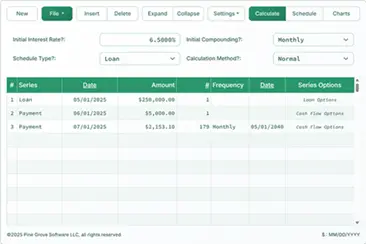
Accurate Interest Calculator
A Brief Introduction to the Interest Calculator
This calculator calculates the interest owed between any two dates. It supports both simple interest and compound interest, with more than a dozen available compounding options. It also supports negative interest rates.
Because this calculator performs date-based calculations, it is well suited for determining interest owed on a debt. You can calculate accrued interest from any date for which the balance is known. More details appear below the calculator…
Related: If you need to calculate interest on a series of payments, deposits, or withdrawals, use the Future Value of an Annuity Calculator.
The Calculator-Calculate Interest Between Any Two Dates
To set your preferred currency and date format, click the “$ : MM/DD/YYYY” link in the lower-right corner of any calculator.
Information
What is compound interest?
Compound interest is interest calculated on both the original principal and on any previously accrued interest. If you pay compound interest or earn compound interest, interest from earlier periods also earns interest.
For example, if the annual interest rate is 2% and you start with $1,000, you will earn or owe $20 after one year (using annual compounding). After two years—assuming no withdrawals or additional payments—the interest earned in the second year will be $20.40, not $20. This is because the first year’s interest also earned interest.
This process is called compounding. It continues as long as the funds remain invested or the borrower continues to owe the debt.
If you are an investor, compounding increases your returns. If you are a borrower, compounding increases your cost—especially if you miss a payment or your payment does not cover the full interest due.
What is simple interest?
Simple interest is calculated only on the original principal amount. For a loan, interest is not charged on any unpaid interest. If you are a borrower, paying simple interest is generally less costly. According to Dictionary.com, simple interest is “interest payable only on the principal.” Under simple interest, interest is never calculated on previously accrued interest.
Using the example above, if the annual interest rate is 2% and you start with $1,000, you will earn or owe $20 in interest after one year. After two years—assuming no withdrawals or additional payments—you will earn or owe another $20.00, not $20.40. Under simple interest, the prior period’s interest does not earn interest.
Additional details
What is Annual Percentage Yield (APY)?
APY is the standardized yield that financial institutions must disclose in the United States for interest-bearing accounts. The Truth-in-Savings Act defines APY as the required disclosure rate for these accounts. Use APY to compare deposit accounts.
What is the “Days In Year” option?
In finance, this is called the “day count convention.”
You can select 360, 365, or 366 days in a year. The “Days In Year” setting affects interest expense calculations when you use simple interest, when you use daily compounding, or when the time span includes a fractional (or stub) period.
What is a fractional period? A fractional period is the extra days between two dates that are not sufficient to complete a full compounding cycle. For example, if compounding is set to “Monthly” and the dates are March 15 to April 20, there are five remaining days. These days form a fractional period—in this case, a fractional month.
Fractional periods may produce results that differ from what you might expect in compound interest calculations. In some cases, a less frequent compounding schedule may produce a higher interest amount than a more frequent compounding schedule.
What is continuous compounding?
Continuous compounding occurs when interest is calculated and reinvested an infinite number of times per period. It represents the mathematical limit of compounding frequency.
What is the impact of negative interest rates?
When interest compounds at a negative rate, the investor effectively pays a fee for holding funds. As a result, the future value becomes less than the present value. To see how this works, try a sample calculation using a calculator that supports negative interest rates—such as this one.
You can use this interest calculator in any of the following ways:
- APY calculator
- Daily interest expense calculator
- Investment interest calculator
- Loan interest expense calculator
- Negative interest rate calculator
- Savings account interest calculator
Because it handles dates accurately, this calculator can also perform date math. For example, given two dates, it can calculate the number of days between them or determine a future (or past) date based on a specified number of days.
Interest Equations
In this section:
- Compound interest equation.
- Simple interest equation.
Compound Interest Equation
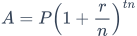
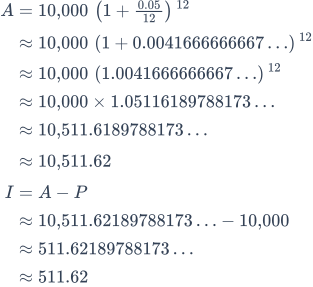
Fig. 2 – Step-by-step solution of the compound interest equation.
Variables: P = 10,000; r = 5%; n = 12; t = 1.
Variable Definitions
- P
- Principal amount (initial investment)
- r
- Nominal annual interest rate (expressed as a decimal)
- n
- Compounding frequency (for example, 1 = annually, 12 = monthly, 52 = weekly, 365 = daily)
- t
- Total time that interest is applied (in the same time units as r, usually years)
- A
- Future value (includes both principal and interest)
- I
- Interest earned.
Calculation Steps
- Substitute the given values into the compound-interest formula (see Figure 1):
A = P(1 + r/n)^{tn}, whereP = 10,000,r = 5%,n = 12,t = 1. - Calculate the periodic rate and update the expression inside the parentheses:
r/n = 0.05/12 ≈ 0.0041666666667…, so the base becomes:(1 + 0.0041666666667…). - Simplify the base:
(1 + 0.0041666666667…) ≈ 1.0041666666667…, keeping the exponent at 12. - Compute the accumulation factor:
(1.0041666666667…)^{12} ≈ 1.05116189788173…, then multiply by the principal10,000 × 1.05116189788173… ≈ 10,511.6189788173…. - Round the result to two decimal places for currency reporting:
A ≈ $10,511.62
Step-by-step Solution – Fig. 2
- A = 10,000 × (1 + 0.05/12)12
- ≈ 10,000 × (1 + 0.0041666666667…)12
- ≈ 10,000 × (1.0041666666667…)12
- ≈ 10,000 × 1.05116189788173…
- ≈ 10,511.62
- I = 10,511.6189788173… – 10,000 = 511.62…
Final Answer
The final answer (A) is approximately 10,511.62, of which 511.62 is interest (I).
Validate the calculator: One-year, monthly compounded interest.
| Starting Amount (PV): | 10,000.00 |
|---|---|
| Annual Interest Rate: | 5.0000% |
| Days (–9,999 < # < 47,482): | <calculated> |
| Start Date (year > 1969): | |
| End Date (year < 2100): | |
| Compounding: | Monthly |
| Days In Year: | N/A |
| Interest Earned: | 511.62 |
| Future Value (FV): | 10,511.62 |
Notes:
- This example uses the same calculation shown in Fig. 2.
- You can enter two dates exactly one year apart. The calculator will automatically calculate the number of days between those dates.
- Or enter a specific number of days (for example, 365 or 366 if the period includes February 29), and the calculator will determine the end date.
- The “Days In Year” setting has no effect in this example, because the period spans exactly twelve months with no extra days.
- With monthly compounding, the total interest for a full year will be the same whether the year has 365 or 366 days.
Simple Interest Equation
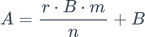
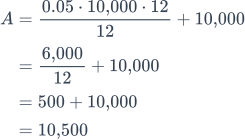
Fig. 4 – Step-by-step solution of the simple interest equation.
Variables: B = 10,000; r = 5%; n = 12; m = 12.
Variable Definitions
- B
- Initial balance (the starting principal)
- r
- Simple annual interest rate (expressed as a decimal)
- n
- Frequency with which interest is applied (for example, monthly or yearly)
- m
- Number of time periods that have elapsed
- A
- Future value of the investment (the principal plus interest)
Calculation Steps
- Multiply the principal amount ($10,000) by the annual interest rate (0.05) and by the number of time periods (12).
- Divide the result from Step 1 by 12 (the number of time periods).
- Add the result from Step 2 to the initial balance.
Step-by-step Solution – Fig. 4
- 0.05 × 10,000 × 12 = 6,000
- 6,000 ÷ 12 = 500
- 500 + 10,000 = 10,500
- 10,500 – 10,000 = 500
Final Answer
The final amount (A) is 10,500.00, of which 500.00 is interest (I).
Validate the calculator: One-year simple interest.
| Starting Amount (PV): | $10,000.00 |
|---|---|
| Annual Interest Rate: | 5.0000% |
| Days (–9,999 < # < 47,482): | <calculated> |
| Start Date (year > 1969): | |
| End Date (year < 2100): | |
| Compounding: | Exact/Simple |
| Days In Year: | 365 |
| Interest Earned: | $500.00 |
| Future Value (FV): | $10,500.00 |
Notes:
- This is the same calculation shown in Fig. 4, except with m = 365 and n = 365.
- For simple interest, the calculator always uses days as the time unit. Therefore, 12 months and 365 days produce the same result: ((0.05 × 10,000 × 365) ÷ 365) + 10,000 = 10,500.00
- You can enter two dates exactly one year apart. The calculator will automatically calculate the number of days between those dates.
- Or enter a value for the number of days (for example, 365 or 366 if February 29 is included), and the calculator will determine the end date.
- The “Days In Year” setting determines the value of n. The “Days” field corresponds to m.
- Because interest is calculated daily, and months have different lengths, the interest for each month may vary. This also applies in leap years.
For an explanation of how interest is applied to an amortizing loan, see the amortization equation.