If you do not see your question answered, please ask below.
advertisement
Frequently Asked Questions
Q. Which calculator should I use to record seller-financed payments and calculate payoff amounts?
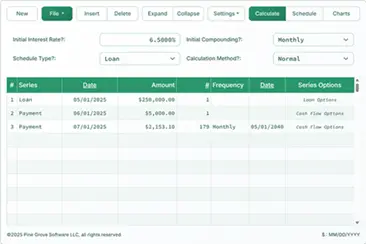
A. Use the Loan Payoff Calculator. You can enter each payment. It supports missed payments, skipped payments, extra payments, and interest rate changes.
Q. Which calculator lets me enter irregular repayments and see the remaining balance?
A. Use the Loan Payoff Calculator. Enter each payment on its actual date. It supports missed payments, skipped payments, extra payments, and interest rate changes.
Q. My lender and I disagree on the amount I owe. Which calculator will compute the current balance?
A. Use the Loan Payoff Calculator. Enter the complete payment history. The calculator computes the balance using your actual payments and any interest rate changes.
Q. How do I calculate the annualized rate of return (IRR) or gross return for stocks, options, bonds, or mutual funds?
Explanation: The rate of return is not equal to the loan’s stated interest rate. The payment was calculated on $45,000 at 6.5% for 48 months. The first payment occurs after a one-year delay. No interest is earned during that year.
Q. Will a $200,000 cash purchase rented at $6,000 per year for 10 years and sold for $220,000 achieve a 9%% return?
A. No. The result is about $58,565 below the amount required to reach a 9% target return. Use the Net Present Value Calculator.
Note:
This investment does not meet the target because the NPV is negative.
Q. Which is better: $150,000 now, or $20,000 for 8 years followed by $10,000 for 5 years?
Q. I will save every other month: $1,000 now, $2,200 starting in 5 years, and $3,000 starting in 10 years. What will the balance be after 5, 10, and 20 years? What if interest rates change?
If your question is not answered, please submit it below.
32 Comments on “Calculator Selection Guide | FAQ”
Questions? Ask them here. We're happy to help.
Woo says:
If I want to calculate the APR required to result in a known total finance charge for the life of a loan, which calculator should I use? I think the APR on a loan is misstated for the total finance charges disclosed on the TIL.

Woo says:
If I want to calculate the APR required to result in a known total finance charge for the life of a loan, which calculator should I use? I think the APR on a loan is misstated for the total finance charges disclosed on the TIL.
Karl says:
I’m sorry that I missed your question until now.
You should use the APR Calculator.