Savings Withdrawal Calculator
What Is a Savings Withdrawal Calculator Used For?
A withdrawal calculator shows how long your savings will last when you make regular, periodic withdrawals. It can also calculate how much you can withdraw so the withdrawals last for the selected time period.
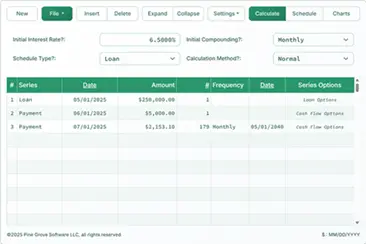
The Savings Withdrawal Calculator calculates withdrawals and creates a withdrawal schedule based on the inputs you provide.

A withdrawal savings calculator that optionally solves for:
- Withdrawal amount
- Starting amount
- Interest rate
- Duration
Creates a printable withdrawal schedule.
Provide at least three of the following inputs to begin. You may set one input to zero to indicate an unknown value:
- Savings on Hand (PV) — The amount of savings currently in your account.
- Regular Withdrawal Amount — The amount you plan to withdraw on a regular basis.
- Number of Withdrawals — The total number of withdrawals you plan to make.
- Annual Interest Rate — The annual interest rate for your savings account.
In addition to these primary inputs, also provide the following secondary inputs:
- Today’s Date — The date on which your “Savings on Hand” equals the amount shown above.
- First Withdrawal Date — The date of your first withdrawal.
- Withdrawal Frequency — How often you plan to make withdrawals (for example, monthly, quarterly, or annually).
- Compounding Frequency — How often interest is compounded on your account.
More below…
The Calculator-Calculate Time or Amount to Deplete Savings
Information

Quickly
Pick a Date
After you enter at least three primary inputs and all secondary inputs, click the “Calc” button to calculate the unknown value, if any. Or click “Withdrawal Schedule” to view your personalized schedule. The withdrawal schedule shows the amount of each withdrawal and the date on which it will occur. The charts provide a visual view of your savings over time and the depletion of the initial balance.
If you need to change any inputs, update the relevant fields and click “Calc” again.
A withdrawal savings calculator can help you make informed financial decisions. By understanding how much you can withdraw each year, you can plan for retirement and other financial goals with greater confidence. You can also adjust your savings and withdrawal strategies as needed to stay on track.
There are several important considerations when using a withdrawal savings calculator. First, the results are based on assumptions about investment returns and withdrawal periods. These assumptions may change over time. Review your strategies regularly to confirm that they still align with your goals.
Second, the calculator assumes that you withdraw the same amount each year, adjusted for inflation. In practice, your needs and lifestyle may change. Be prepared to adjust withdrawals when necessary.
Finally, the calculator does not include other income sources such as Social Security or pensions. These sources can significantly affect your withdrawal strategy, so include them in your overall financial plan.
We hope you find this calculator helpful for planning savings withdrawals. If you have questions or feedback, please submit them below.
Withdrawal Savings Calculator Help
The savings withdrawal calculator is flexible. It is most often used to calculate how long an investment will last when you make periodic, regular withdrawals. It can also solve for the “Starting Amount”, “Annual Interest Rate”, or “Regular Withdrawal Amount” when you want to set the payout duration. For example, if the withdrawals must last 25 years, the calculator can compute any one of these three values.
Enter any three values, and enter “0” for the unknown value.
A note about “Compounding Frequency”. Selecting the “Exact/Simple” option turns off compounding. The calculator uses the exact number of days between withdrawal dates to calculate interest for each period. The “Daily” option also uses the exact number of days, but it assumes daily compounding (interest earned each day is added to principal each day). The “Exact/Simple” setting is the most conservative option because it produces the lowest future value. Daily compounding produces nearly the highest future value (except for “Continuous Compounding”).
The other compounding frequencies use periods that are not based on days. Each period is assumed to be of equal length for interest calculations. For example, with a balance of $10,000, the interest for January will be the same as the interest for February, assuming the same interest rate.